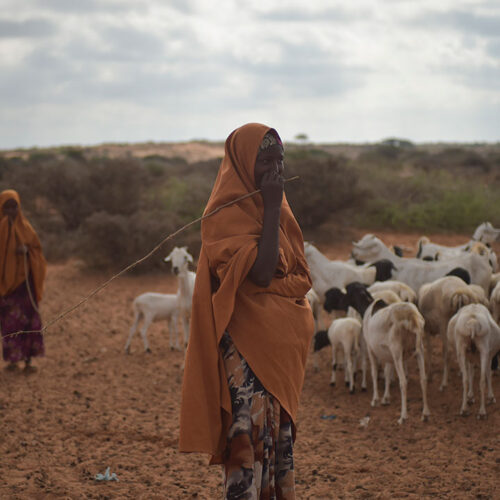
The Center is conducting comparative field research in Afghanistan, Pakistan and the Horn of Africa to examine the effectiveness of development assistance in promoting stabilization objectives. The belief that aid “wins hearts and minds” and is an effective “weapons system” in counterinsurgency operations is having a major impact on aid policies and counterinsurgency strategies.
There is a widely held assumption in military and foreign policy circles that development assistance is an important “soft power” tool to promote stabilization and security objectives in fragile states. Counterinsurgency doctrine in particular emphasizes the importance of reconstruction assistance in “winning hearts and minds” of civilian populations and in promoting stabilization. This assumption is having a major policy impact on how development assistance is apportioned and spent, and provides an important rationale for the growing ‘securitization’ of development assistance.
Given how widespread the assumption is, and given its major impact on aid and counterinsurgency policies, there is to date little empirical evidence that supports the assumption of a causal link between reconstruction assistance, “winning hearts and minds,” and/or improved stabilization and security. While considerable time, effort and resources have been devoted to assessing the effectiveness of aid in achieving humanitarian and development objectives, surprisingly few resources have been devoted to assessing the effectiveness of aid in achieving stabilization and security objectives.
FIC is conducting comparative field research in Afghanistan, Pakistan and the Horn of Africa to examine the effectiveness of reconstruction aid in promoting stabilization objectives. The main objective of this research is to try to answer the question: How effective is development aid in promoting stabilization objectives? Some of our initial findings suggest that in Afghanistan and the Horn of Africa there is little evidence that development assistance, intended in part to “win hearts and minds,” has contributed significantly to improved stability or security.
Publications
- Winning Hearts and Minds? Examining the Relationship between Aid and Security in Afghanistan
This paper by Paul Fishstein and Andrew Wilder presents findings from research conducted by FIC in five provinces of Afghanistan between July 2008 and January 2010 on the relationship between aid projects and security.
- Winning Hearts and Minds? Examining the Relationship between Aid and Security in Afghanistan’s Helmand Province
This third Afghanistan provincial case study examines the use of aid, including “Quick Impact Projects” (QIPS), from 2006-08 to attempt to produce stability in an area of Afghanistan which has been among the most insecure and which has been a major focus of financial and human resources.
- Winning Hearts and Minds? Examining the Relationship between Aid and Security in Afghanistan’s Faryab Province
This second provincial case study, authored by Geert Gompelman, examines the drivers of insecurity, characteristics of aid projects and aid implementers, and effects of aid projects on the popularity of aid actors and on security in an area of Afghanistan which has been among the most peaceful, but which has significant pockets of insecurity. Faryab differs from the other provinces in that the Norwegian-led Provincial Reconstruction Team (PRT) does not have a civil-military coordination function and does not directly implement development projects, instead channeling its aid through the central government, multi-lateral institutions, and non-governmental organizations.
- Winning Hearts and Minds? Examining the Relationship between Aid and Security in Balkh Province
This new case study by Paul Fishstein examines the drivers of insecurity, characteristics of aid projects and aid implementers, and effects of aid projects on the popularity of aid actors and on security in an area of Afghanistan which has been among the most peaceful, but which over the last year has seen increasing insecurity. The research confirmed the widespread expressed dissatisfaction with post-2001 development activities, sometimes in contradiction of on-the-ground realities.
- Winning Hearts and Minds? Examining the Relationship Between Aid and Security in Kenya
This case study on Kenya, researched and written by Mark Bradbury and Michael Kleinman, is the first in a series of publications presenting the findings of a two-year FIC comparative study on the relationship between aid and security in northeastern Kenya and in five provinces of Afghanistan. The overall study has focused in particular on trying to determine the effectiveness of aid in promoting stabilization and security objectives, including by helping to “win hearts and minds” of local populations.
Multimedia
- Opposed Development: Concept and Implications. Presentations by David Kilcullen, Andrew Wilder, Andrew Natsios, Nancy Lindborg, and James Schear at the U.S. Institute of Peace. July 2010.
- Interview with Andrew Wilder on CNN by Christiane Amanpour. December 2009.
- Interview with Andrew Wilder on research findings on NPR’s “Morning Edition,”. November 2009.
- Theory Meets Practice: Counterinsurgency in Afghanistan. Presentations by David Kilcullen and Andrew Wilder at the US Institute for Peace. June 2009.
- “The Real Problem in Afghanistan”. By the Tufts Journal. November 2009.
Partners
This research has been generously supported by the Afghanistan Research and Evaluation Unit, and the governments of Australia, Norway and Sweden.