Category Archives: Sustainability News - Get RSS Feed

TSC holds Fall Sustainability Roundtable

TSC's Fall Roundtable drew members from the CSC working groups and various sustainability-related organizations around campus

Tufts Sustainability Collective, the active umbrella organization for environmental groups on campus, has been very busy the past two weeks! The student-run group hosted two successful events, a Sustainability Roundtable and a Sustainability Dinner at Dewick. Both of these events have become staples each semester, so if you missed them this time around, look for their reappearance in the spring!

This fall’s Sustainability Roundtable featured the Campus Sustainability Council‘s three working groups for Energy and Emissions, Waste, and Water. Each group presented their goals for the university and their progress since convening earlier this year, pursuing a dialog with members of the Tufts community, from students to the head of Facilities.

Energy and Emissions team-members noted the achievement of meeting the standards set by Kyoto protocol by 2012 and mechanisms for decreasing the university’s carbon footprint, such as increased efficiency and switching fuels to natural gas or to distributors with renewable sources. In order to reduce energy consumption as the community continues to grow, however, a university-wide effort is called for, and the educational aspect of this goal is where the Office of Sustainability comes in!

The Waste working group focused on reducing outputs to the landfills during new construction projects and building rehabilitation. They mentioned many waste-reduction goals and plans to collaborate with Tufts Facilities in particular to “use less, reuse and recycle more” before anything is dumped in the trash.

The Water team had great news to present, including some concrete actions already in motion on the Tufts campus! Projects so far have included water reuse systems for machinery in laboratories and elsewhere, reducing the water coming in by hundreds of thousands of gallons already, and the recent construction of a university rain garden near the lower campus dorms. Rain gardens are both visually appealing and ecologically sound, ensuring rainwater is infiltrated into the soil, cleaned naturally, and returned to the groundwater rather than sent with pollutants down the storm drains. The Water working group also discussed plans to enter the EPA’s RainWorks Challenge, a national infrastructure design competition, and to look into porous pavement and gray water systems.

Read more about what was discussed at the roundtable in Tufts Daily’s news article.

-written by Anne Elise Stratton

The Candidates and the Climate

While no candidate is perfect on climate change (and indeed, they all seem to be woefully inadequate), there are some differences:
 
PRESIDENT
Mitt Romney: despite his surprisingly good record on climate change while he was governor, Romney’s energy plan focuses almost entirely on pumping more fossil fuels into the atmosphere, a situation that would almost certainly ensure the world’s inability to reign in climate change (Rolling Stone has a pretty fierce write up of it, but you can read it yourself and see). Just one example: in his quotes about N. American energy independence, he uses a Manhattan Institute report that says, “In collaboration with Canada and Mexico, the United States could—and should—forge a broad pro-development, pro-export policy to realize the benefits of our hydrocarbon resources. Such a policy could lead to North America becoming the largest supplier of fuel to the world by 2030.” (what no-one seems to have told him, however, is that oil and gas companies that drill in N. America aren’t restricted to selling that fuel only to Canada, Mexico and the US – they’ll sell it to whomever gives the best price – as any good, non-government-run institution would do).
 
But anyhow, Obama’s no great climate champion these days either but at least he doesn’t blatantly ignore climate change or pledge to dig up and sell all the fossil fuels in North America. As an aside, Romney attacks Obama for ‘targeting old coal power plants’ – when, really, we wish he were targeting them, since those plants are some of the worst carbon emissions offenders.
 
Here is a summary of what the 2 candidates have said about energy and climate on the campaign trail.
 
US SENATE
Elizabeth Warren seems to support action on climate change – at least in words – but I doubt it’ll be a priority for her. Scott Brown, however, in June 2012 voted to ‘disapprove’ the EPAs endangerment findings on greenhouse gases and in March 2012 voted against ending tax deductions for major oil companies and extending incentives for energy efficient homes, plug-in vehicles and alternative fuels. They are considered one of 4 senate races with noticably different opinions on climate.
 
US HOUSE 
Jon Golnik doesn’t list ‘environment’ as an issue on his website, but under ‘energy’ he indicates he supports the Keystone XL pipeline, fracking and drilling in ANWR. OK, I guess that says it all. Climate doesn’t seem to be a priority for Niki Tsongas, but she states that she help[ed] to pass tougher fuel efficiency standards and incentives for renewable energy, so there’s hope there.
 
Don’t forget to vote!

Do It In the Dark

This week we are going to talk about the Eco-Rep initiative DO IT IN THE DARK (DIITD).  With the help of facilities we’re comparing the electricity usage from mid-October – mid-November 2011 to mid-October – mid-November 2012.  Since weather differences won’t make much of a difference with for electric usage, it should be a fair comparison.  We as students can make a tremendous difference by doing simple things like remembering to turn off our lights and computers when we leave for class.  Just switching our desk lamp to a CFL from and incandescent bulb save 75% of the electric used.  Below are some Fun Facts about how to save energy at Tufts.

Fun Energy Facts:
- 90% of the energy that goes into an incandescent bulb is wasted as heat.
- If everyone in a South a floor lamp with an incandescent bulb while they’re at class it would save 23kWh of electricity.
- If you don’t unplug your mini-fridge when you leave for Winter Break, you’d waste 20kWh of electricity.

Campus Sustainability Council Fall 2012 Update

During the summer, the Tufts Sustainability Council’s various working groups met to discuss goals for Tufts in the areas of water, waste and energy/emissions reductions.

The Water Working Group envisioned Tufts having an integrated water management approach that reduces consumption, promotes reuse, and minimizes impacts on the environment enabling Tufts to become a leader in campus water management in higher education.

To reach this goal, the Water Working Group recommends that Tufts meets and exceeds federal, state and local regulations regarding runoff, sanitation, and sewer systems; implements LEED standards for water use and quality; and ensures that Tufts students, faculty, and staff are knowledgeable of how their actions impact water use and quality and know how to mitigate negative impacts on their watersheds.

The Waste Working Group’s primary goal as discussed during their Summer meetings is an overall reduction of waste at Tufts by 3% a year through source reduction, improved waste management strategies, and a general culture change on campus with regards to waste.

Part of the Waste Working Group’s proposed strategies involves improved purchasing practices to ensure that an increased percentage of environmentally responsible products are purchased by the university.

The Energy and Emissions Working Group discussed ways for Tufts to demonstrate leadership in responsible climate action through energy efficiency, emissions reduction and adaptation. Under the New England Governors/Eastern Canadian Premiers Climate Change Action plan, the Energy and Emissions group is committed to seeing Tufts reduce emissions to 10% below 1990 levels by 2020 and reducing emissions to 75-85% below the 2001 levels by 2050.

To do this, the Energy and Emissions group is developing a laundry list of energy efficiency measures and is committed to supporting a transition away from fossil fuels and teaching the Tufts community about the importance of energy efficiency, reduced energy consumption, and reduced emissions.

The groups stressed a need for reporting, feedback, and community outreach to ensure that all of Tufts sustainability efforts and goals can be reached.

Over the remainder of the semester, the Water, Waste, and Energy/Emissions groups will be meeting to discuss progress towards these goals, ongoing sustainability efforts, and additional strategies the university could use to meet their goals. A draft report will be available on February 1st, 2013 for comments. The comment period will end on March 1st and a final report will be prepared for the end of the academic year.

- by Robert R. Lynch, Campus Sustainability Council Administrative Intern

Tips for Zero-Waste Week

It’s easy to do the Zero Waste Challenge when you are at a place like Tufts, where recycling bins abound and compost drops are available on campus. Still, here are some good tips to keep in mind:

  • Snack on fresh fruit – it’s healthier AND it’s compostable.
  • Carry a small tupperware to put food to compost later.
  • Bring your lunch and use the container to get takeout for dinner.
  • Get your drinks without a straw.
  • Avoid individually wrapped tea or drink loose leaf tea.
  • Always bring a reusable mug or water bottle.

    Photo courtesy of Tufts Dining

    • Save 20 cents at Mugar Cafe, Tower Cafe, Brown & Brew, Hodgdon Good-to-Go & Commons Deli if you bring your own mug.
    • The Tufts “Choose to Reuse” clear water bottle will get you a discount on any fountain beverage at Mugar Cafe, Hodgdon Good-to-Go, Commons Deli, and Tower Cafe. Water and sparkling water will also be discounted at Hotung Cafe.

A few things to remember:

  • Aluminum foil and yogurt cups are recyclable.
  • All napkins are compostable.
  • Any rigid plastic can be recycled – including coffee stirrers. (It doesn’t have to fit through the openings of the recycling bin, by the way – just lift the cover.)
  • Energy bar wrappers and chip bags are recyclable. Tufts has Terracycle brigades on campus.

For more information on recycling and composting at Tufts, visit the TuftsRecycles! website.

Good luck and have fun!

Eco-Reps Weekly Updates

Zero Waste Week

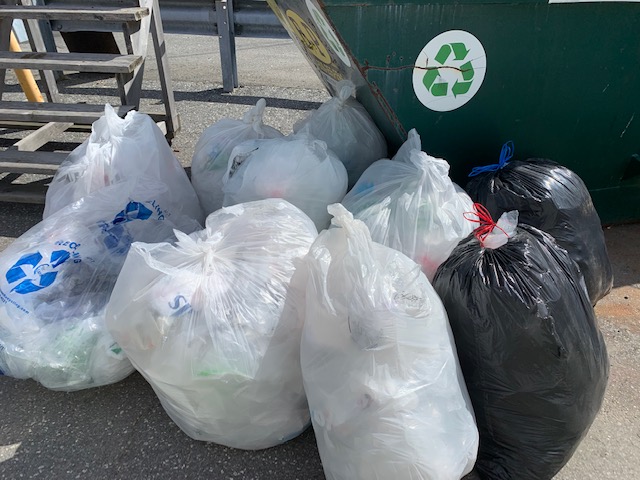
Today, October 17th, is the start of Zero Waste Week! From October 17th to October 24th, 200 students will participate in this challenge to raise awareness that trash doesn’t just “disappear.” Participating students will place all trash that will not otherwise not be recycled or composted in a clear plastic bag that they will carry around with them for the week. Students should feel less compelled to create waste since they’ll have to carry it all with them! The plastic bags will be dropped off on the RezQuad at Mt. Trashmore on October 24th and the amount generated by the participants will be compared to the trash generated from a comparable sized dorm.  Visit the Office of Sustainability, the Crafts House, or find your Eco-Rep to be a part of the challenge!

Sustainability Day

October 24th, the end of Zero Waste Week, is also Sustainability Day! This event, taking place from 5:00 pm to 10:00 pm, focuses on raising awareness of what has been done and what needs to be worked on to become a sustainable campus. Events for this year’s Sustainability Day include Mt. Trashmore, which will feature individual piles of trash taken from Miller, Houston, Carmichael, and Hill Halls, and “The Story of Bananas” dinner at Dewick. “The Story of Bananas” dinner seeks to educate students on the path of the dining halls’ most eaten fruit from farm all the way to compost. Check out the five stations, play the fun foodie game to win banana themed prizes, and enjoy foods with bananas! In addition, Annie Leonard, the author of “The Story of Stuff” will be holding a talk, question and answer, and book signing session in Cohen Auditorium from 8:00 pm to 10:00 pm.

Eco-Rep Events

Last night Eco-Rep Sidney May, the Eco-Rep for Wren Hall, held her first event. She set up a tap water vs bottled water taste test and raffled off a Brita reusable water bottle! Sidney threw residents a fun curve ball by serving only tap water. Residents had fun doing the test and were almost always surprised they tried two cups of tap water. Way to go, Sidney!

Hill and West residents, don’t miss the Sustainability Dinner event tomorrow night put on by Eco-Reps Chantal Davis and Laina Piera. The dinner will focus on sustainability of the food in the dining halls. You can’t miss the delicious Flatbread pizzas they’ll be serving for dinner! The event takes place from 6-7pm in the Hill Hall Lounge.

Plus, look out of Do It In the Dark, an inter-dorm competition to see which can reduce their energy consumption the most over a one-month period! More information to come in our next post!

Chemistry Dept Eco-Ambassador wins grant for 2012

"The talk around the water cooler is about the water cooler."

There’s a new water filter system in the Chemistry Department and they have Eco-Ambassador Sarah Iacobucci to thank for it.

Iacobucci – an Eco-Ambassador from the 2010-2011 class – applied for and won a $200 grant from the Office of Sustainability last summer. She writes, “We had a water filter system installed in a location in which we were told it was not possible to install one. Everyone loves it! We also bought a bunch of water pitchers for the department meetings and they are a big hit, too!”

To be eligible for a grant, Eco Ambassadors need to have attended 8 or more Eco-Ambassador sessions in any year and not have already received a grant. Previous winners include:

  • Jess Warner, Tisch Library: compost bins
  • Anita Robbins, Feinstein Center: Brita water pitchers
  • Carla Walsh, Education: incremental cost of new, energy efficient fridge
  • Kris Thompson, Tisch Library: Eco-grant book contest (which were featured in a library exhibit last spring as part of Earth Week events)

Grant proposals were evaluated on potential impact (How much waste, energy, water is saved and how many people are affected) and the potential to influence follow-up behavior change.

Congratulations Sarah! We look forward to more proposals to help make Tufts a greener workplace.

For more information on the Eco-Ambassador program, visit http://go.tufts.edu/ecoambassadors.

Eco Reps enjoy retreat to New Hampshire

The 2012-2013 Eco-Reps spent the last week of August training for the new school year. While most of the training took place on the Medford campus, the group took an overnight retreat on the last night of training week to Woodstock, New Hampshire, to spend time getting to know one another, hiking, and training Tufts’ “loj.”

The group, which included the 15 Reps, 2 coordinators, and Tina Woolston, the Director of the Office of Sustainability, arrived in New Hampshire on Friday afternoon, August 31. They spent the afternoon and evening hanging out, cooking, and roasting marshmallows.

Early Saturday morning, the whole group woke up to go on a hike of Mt. Tecumseh. The hike lasted through the morning, and gave the Reps an opportunity to grow together, through partner hikes and trail games. At the peak, the group enjoyed a picnic lunch. Standing tall at 4,003 feet, the summit provided great views of the surrounding forests and mountains.

The entire group of Eco Reps enjoy the view from the top of Mt. Tecumseh. The hike was an exciting part of the Eco Rep retreat at the end of August.

After returning from the hike, the group had a busy early afternoon of training. They started by brainstorming events for the upcoming semester. Each Rep is responsible for three dorm-wide events each semester, and this brainstorming session led to a lot of ideas for how to plan successful events.

Next, they troubleshot how to handle difficult scenarios and situations that may come up throughout the year. To conclude the day, the Eco Reps re-evaluated the goals they had set at the start of training week, and prepared to leave the loj.

After a great overnight retreat, the Eco Reps returned to campus ready to take on the fall semester!

Sept 18 & 21: Mass. Car-Free Week Kick-Off & Celebration

Tufts Office of Sustainability is celebrating Massachusetts Car-Free Week September 17th-23rd by encouraging students and faculty members to make their commutes car-light!

Endorsing the environmental, financial, community, and health benefits of sustainable travel options, Mass. Car-Free Week promotes public transit, carpooling, bicycling, walking and teleworking as greener modes of transportation.

Track your progress on www.nuride.com, a travel rewards and ride-sharing program sponsored by the Massachusetts Department of Transportation. Win daily prizes for commuting car-free by signing into NuRide from September 17th-23rd!

Tufts Office of Sustainability will guide you through Mass. Car-Free Week with Kick-Off and Celebration events:

Kick-Off: Tuesday, September 18th, 11am – 2pm: Tufts Office of Sustainability (OOS) will host a kick-off event on the lower patio of Mayer Campus Center to promote the environmental and economic benefits of car-light commuting for Mass. Car-Free Week. The OOS will be signing up students and staff for Car-Free Week via NuRide. Come join the local biking and alternative transit community to register your bike, pick up bike maps and flyers, purchase bike locks and other transit merchandise, and learn about everything from folding bikes to car-sharing!

Celebration: Friday, September 21st, 11am – 2pm: There is such thing as a free lunch! Tufts Office of Sustainability will offer a free lunch for all registered participants in Mass. Car-Free Week. Enjoy a meal in the Pearson parking lot (across from Dewick dining hall), where Professor Cathy Stanton’s Anthropology 132 “Myth, Ritual, & Symbol” class  will demonstrate alternative uses for an open parking space. Please RSVP to the lunch either by sharing a picture of your car-light ride on our Twitter (@tuftsOOS) or Facebook, or by sending us an email of your NuRide account progress at tuftsoos@gmail.com.

To learn more about Mass. Car-Free Week and other events in the Boston area, visit the MassRIDES website.

Aug 10: Deadline for Greenbuild Scholarship Applications

The 2012 Greenbuild scholarships will bring together a diverse group of people from around the world who have important roles to play in the green schools movement, and give them the opportunity to participate in and learn from the largest green building conference and expo in the world!

All-expense paid trips to the 2012 Greenbuild Conference and Expo will be awarded to students, faculty, staff and other stakeholders within the higher education sector. The Center for Green Schools and USGBC distribute scholarships to promote diversity and social equity within the green building industry and the green schools movement.

Benefits for 2012 scholarship awardees include:

  • All-expense paid trip to Greenbuild 2012 in San Francisco from Nov. 13-16
  • Meet and connect with high-level professionals in the green building industry
  • Network with other college and university representatives
  • Participate in special on-site programming at Greenbuild that will include complimentary breakfasts, speaker presentations and an honorary dinner
  • Receive training and support from USGBC staff and other green building professionals
  • Free access to LEED 101 and LEED 201 online courses
  • Earn continuing education hours to satisfy GBCI’s LEED professional credential maintenance requirements
  • Play an integral role in advancing social equity within the green schools movement

Students interested in Greenbuild scholarships should also consider applying for mentorship opportunities with USGBC Board members. Board members support students in pursuing studies and careers in fields related to sustainability by offering professional advice, networking opportunities and career building experiences.

Apply on the USGBC website today!

Switch to our mobile site