Music
“Music is a therapy. It is a communication far more powerful than words, far more immediate, far more efficient.”
Yehudi Menuhin
Definition of Music
This quote by Yehudi Menuhin, a British-American violinist whose parents immigrated to the United States from Eastern Europe, perfectly encapsulates the social purpose of music.1 It is a voice for the voiceless, and it is a mode of global communication across physical and societal boundaries. While acknowledging this, we also maintain that music is a complex, social practice that can be analyzed through multiple different lenses. It is a tool to shape and bridge societal norms. Music in its literal and more obvious meaning is an artistic outlet with a melody and rhythm that allows people to express themselves. However, a deeper analysis of music reveals the different ways that music can define a person or a group of people and their respective differences/identities. By aiding in creating a definitive identity, music overall has proven to have the power to mobilize groups of people to create and sustain a culture through diaspora and despite discrimination. Our group defines music as an artistic outlet that promotes social cohesion and serves as a bridge between people of different cultures and backgrounds. It is a tool of connection, but also one of cultural specificity.
Music is an expansive concept ranging from an art form to a mode of expression and transformation of norms. It is such a powerful tool that fosters connectivity across cultures, communities, and generations. Music’s versatility allows it to extend far beyond sound alone; it intersects with social movements, identity formation, education, and so many other areas of life. For this reason, the following keyword page is structured around the framework of “Music in/as…” to highlight the many spaces in which music plays a critical role.
Music as an Art
Music is more than just rhythm and melody. It is a creative expression that comes from cultural memory, lived experience, and artistic innovation. The Harlem Renaissance of the 1920s and 30s is a perfect example of music functioning as transformative art. Jazz broke many musical rules with its syncopated rhythms and improvised solos, drawing thousands of people night after night to see the same performers. Jazz became the first originally American style to affect music around the world2. By blending blues rhythms with improvisation techniques influenced by traditional West African music, jazz became a representation of black culture’s resilience and innovation. The first piano style incorporated into jazz was Harlem Stride3, which helped blur the lines between poor and wealthy African American communities. Musicians like Duke Ellington, Bessie Smith, and Louis Armstrong didn’t just perform music. They reimagined what music could be and what it could accomplish as an art form.

Louis Armstrong4, widely known as the father of jazz.
Music in Community
Music is a powerful force for building and sustaining communities, especially for groups facing displacement and discrimination. Music nurtures social cohesion which moves individuals into a collective group. When people gather to create or experience music together, they form bonds that transcend all language barriers, economic differences, and cultural boundaries. The role of music in forming communities becomes especially important during periods of migration and cultural upheaval. During the Great Migration5, hundreds of thousands of African Americans relocated from rural South to urban North. Through music African Americans created an explosion of cultural pride.
The Harlem Renaissance is a great example of music’s community building power. It is a movement of African American music, dance, art, fashion, literature, theater, politics , and scholarship centered around Harlem. This movement showed how a displaced and oppressed community could use music not only to maintain its cultural heritage but to assert its humanity and demand recognition. Writers like Langston Hughes6 wrote with the rhythmic meter or blues and jazz, creating literature that was inseparable from the musical community that inspired it. The community that formed in Harlem through music became a model from African American urban communities across the United States. It proved that African Americans could achieve artistic excellence and commercial success while maintaining their cultural identity. The lessons of the Harlem Renaissance remain relevant today as communities all over continue to use music as a tool for building solidarity in the face of displacement and discrimination.
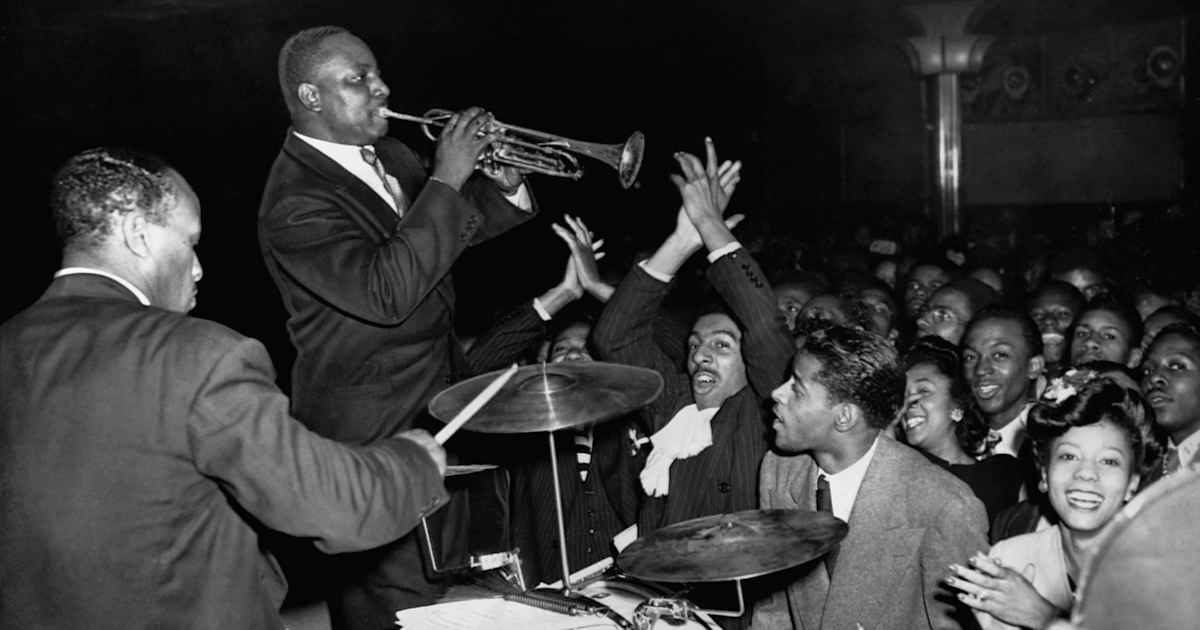
Legendary jazz artist Cootie Williams, playing for a bouncing audience.7
Music in Protest
Music serves as a means of protest communication, helping transform frustration into hope and a vision for justice. Across cultures and historical eras, music has served as a means to convey expression over an issue and a desire for change because it is memorable, can invoke deep and powerful emotions, and can generally reach a broader audience. Music brings connection and, through a shared identity, people feel empowered to advocate for change.
The Civil Rights movement, a more than a decade-long fight for equal rights and treatment of African Americans, used music as a tool to critique existing power dynamics between people of different cultures.8 The following is an example of a song used in protest:
Lyric Video of Pete Seeger’s “We Shall Overcome” 9
The song “We Shall Overcome” critiques the existing social hierarchies through communal expression. This piece showcases music as an act of protest itself. Through the repetition of “We,” “We Shall Overcome,” and “We are not Afraid,” it demonstrates solidarity in protest and having the courage to keep fighting for change. In fact, the song’s history traces back to a group of Black women who first sang it as a protest anthem during a strike against the American Tobacco Company, and later changed the lyrics from “I Shall Overcome” to “We Shall Overcome.” This change was intended to promote further unity and did. As a result, it became a symbolic anthem for the civil rights movement.10 With every repeated phrase and inclusion of those represented in the lyrics, the group’s identity, those voicing a desire for change, was strengthened.
As clearly shown above, ‘protest music’ uses repeated phrases, making it easier for people to join in, regardless of musical talent. This fosters inclusivity and further transforms protest from something observed to something performed; through music, everyone can participate rather than spectate.11
Moreover, “We Shall Overcome” illustrates that, now, “protest music” not only communicates frustration but also actively motivates participants. The song provided emotional steadiness to individuals as they marched into unknown risks, such as facing police lines. Music strengthens morale and helps encourage people during marches and rallies. It also reduces fear. Music can carry stories and memories.12 Music can serve as a reminder of past and present struggles in the hope of a better future filled with justice and equality.
Music in Canon
Music of non-dominate cultures is underrepresented or excluded in academic settings. In many of these settings, the primary focus is on white, European, male composers (like Mozart, Beethoven, Bach, etc), who inaccurately represent music more broadly. Music provides reflections on social hierarchies and cultures. When institutions repeatedly present the same white male composers, the opportunity for exploring, understanding, and accepting others’ identity is lost. Music is not equally represented in academic settings.13


Graphics on the socially inferred percentages of gender and race conducted from an American Community Survey14
In the graphs above, the key areas for review are on the fourth columns. These graphics reveal how the teaching of music is predominantly of white males and that when researchers investigated representation in music, the representative percentages of gender and race were not of close comparison. This demonstrates how the academic study of music focuses so heavily on white male figures like Mozart and ignores other areas of musical influence. The data helps further critique music studies as it makes visible the inequity in what is being studied.
Misrepresentation also translates to how people listen to music. It affects what people deem as “good music” because it is directly correlated to exposure and repetition. People also tend to be more emotionally connected to music that reflects their identities and are normalized in their education. However, with this lack of diversity in academic settings people may not feel adequately represented.15
While historically, music academia has focused predominantly on Euro-western males, this primary lens is starting to shift. According to the Journal of American Musicological Society, we as a society are developing a “more attuned focus to intersectionality, [and that] dialogics over the Western art music canon have produced significant scholarship and new areas of critical inquiry: music and class, disability, the environment, ethnicity, gender, labor, nationalism, race, sexuality––who people are as musicians and how they practice musicking in the…world.”16 As a result, scholars are expanding the canon of musical study and actively examining how the canon itself was constructed and how certain identities came to be excluded, therefore deepening what music came to be valued as “serious or important.” This framework of thinking aims to recognize all participants of music equally. While this is still a newer wave intellectual study it is becoming more prominent and will encourage a broader view of musical influence.
Music in Identity
According to Patrick Burke, an ethnomusicologist, music is less of a universal language and more of “a universal behavior and a universal preoccupation.” He asserts that “everyone is a musician,” and that music is completely subjective to one’s own lived experience or personal preference.17 This promotes the idea that music isn’t just the polished, studio-mixed songs that are popular on the radio; it’s the poems and compositions that we have carried with us through generations that shape our respective identities.
An example of music promoting cultural identity is the album Epilogue to the String Band Tradition, found in the Smithsonian Folkways Recordings. Recorded in 1956, this album attempts to preserve nearly-forgotten “old-time Spanish dance music” from Venezuela.18 Epilogue boasts eighteen tracks, played by the Grand Curucaye String Orchestra of Trinidad, with each song including the signature picatto, plucked-string style that makes this type of music so unique.
Through preserving the specific musical tradition of plucked-string Spanish dance music, the cultural identities of the people of Venezuela and Trinidad and Tobago are also preserved. By continuing to listen to and play this music that soundtracked many lives in Venezuela and Trinidad and Tobago, their respective cultural identities are thereby promoted and celebrated, identities that would have been lost to time otherwise.
YouTube recording of the first song on Epilogue, Joropo: Manita Octavo.19
An example of music promoting personal identity is the song “The Blacker the Berry” by Kendrick Lamar. This five-minute and twenty-eight second song is one of Lamar’s most impressive and complicated. Throughout the song, he grapples with the duality of his African-American identity against the backdrop of American police brutality and systemic racism. He ponders what it means to be “Black” and how he represents his respective community. Although not sung by Lamar himself, but by a Jamaican artist by the name of Assasin, the lyrics “How you no see the whip, left scars ‘pon me back/But now we have a big whip parked ‘pon the block/All them say we doomed from the start cah we Black/Remember this, every race start from the Black, jus ‘member dat” highlight the struggle of maintaining a cohesive identity despite an extensive history of cultural diaspora and oppression.20 In the first two lines, Lamar’s song juxtaposes the experience of African-Americans in slavery and the current experience of African-Americans as an oppressed minority in America. Through this comparison, Lamar acknowledges his connection to those who experienced slavery and attaches it to his own personal identity as a rich Black man. In the last two lines, Lamar discusses the African diaspora, calling it the genesis of all races. This is extremely important to Lamar’s personal identity, as seen through the repetition of the word “remember.”21 In live performances of this song, Lamar frequently utilizes symbolism to put his identity as a Black man in America at the forefront of the performance. One of the most notable examples of Lamar’s extensive use of symbolism is in his 2016 Grammy’s performance of “The Blacker the Berry,” which featured various backup dancers in chains and in prisons, representing the oppression and racial bias that African-Americans face everyday because of their personal identities.
One of the most prominent musical examples of Blackness being critical to Lamar’s personal identity is his 2025 Super Bowl Halftime Show performance. This performance featured hits such as “squabble up,” “tv off,” “Humble,” “All the Stars” and “Not Like Us.” This performance marked an important point in Lamar’s career: performing on arguably the biggest stage in American pop culture. Similar to his Grammy’s performance, he decided to use this opportunity to showcase various aspects of his experience as a Black man in America, specifically as a Black man trying to create music. In order to achieve this, Lamar incorporated solely Black dancers and various Black celebrities such as SZA, Serena Williams, and Samuel L. Jackson, all either dressed in red, white, or blue. The theme of the performance was “The Great American Game,” and this theme was employed through commentary from Samuel L. Jackson’s character Uncle Sam. In between songs, Uncle Sam scolds Lamar for not knowing “how to play the game,” calling him “too loud…too Ghetto,” reflecting the real insults that Black artists face while trying to establish themselves in the white-dominated American music industry.22 Through this protest performance, Lamar emphasized personal Black excellence and uniqueness while also highlighting the struggle that African-Americans still face today due to to the racism and bigotry that is extremely prevalent in American society.

Kendrick Lamar performing “The Blacker the Berry” at the 2016 Grammy Awards, surrounded by actors in prison uniforms and chains.23
Music as Empowerment
Through all of these various forms of music as a mode of expression and transformation of norms, music also serves as a way to empower those who struggle for freedom and acceptance. Often called the Black National Anthem, the hymn “Lift Every Voice and Sing” is the ultimate example of empowerment through music. This song has long been associated with struggles for Black liberation, with it first composed in 1900 by James Weldon Johnson and still sung today. The first known performance of this song was a choir of 500 children in Jacksonville, Florida celebrating Abraham Lincoln’s birthday. The NAACP notes that “Lift Every Voice and Sing” was used frequently throughout the Civil Rights Movement as a “rallying cry,” which highlights the song’s empowering nature.24
The whole hymn has a serious yet hopeful tone, but the lyrics are especially empowering: “Sing a song full of the faith that the dark past has taught us,/Sing a song full of the hope that the present has brought us;/Facing the rising sun of our new day begun,/Let us march on ’til victory is won.” This hymn highlights that although there is still much to be done in terms of acceptance and equality, there is so much to be hopeful about and thankful for, such as “the hope that the present has brought us.” It encourages its listeners to keep moving forward, keep “march[ing] on ‘til victory is won.”25 Many Black artists have incorporated covers of this song into their discographies, with one of them being Beyoncé, one of the most decorated and celebrated artists of this generation. Her massive influence on American pop culture has allowed her to be a powerful advocate for social change and Black empowerment. One example of Beyoncé’s advocacy is her performance at Coachella Music Festival in 2018 as the first Black female headliner. Throughout her performance, she featured many aspects of Black culture, such as nods to Black fraternities and symbols of Black resistance. Most importantly, she performed a cover of “Lift Every Voice and Sing,” which served as a powerful homage to the past and ongoing fight for Black empowerment, liberation, and acceptance.
Beyoncé performing “Lift Every Voice and Sing” at Coachella in 2018 as the festival’s first Black female headliner, as featured in her film Homecoming: A Film by Beyoncé.26
Conclusion
Music is a complex and ever-evolving process and art form. It can be used in many different contexts to portray many different narratives and experiences. In the context of race, colonialism, and diaspora, music has specific functions, including but not limited to: a means of protest and representation, identity, and empowerment. Overall, music serves to form communities and strengthen shared histories and identities that would have otherwise been lost to time. Through the preservation and continual creation of music, various identities, cultures, and experiences that may have been silenced or unheard can now receive the attention and respect that they deserve.
Works Cited
- Tassone, Stephanie Tassone. 2016. “Yehudi Menuhin’s centenary: “Music is a therapy.”” Medium. https://medium.com/discover-classical-music/yehudi-menuhin-s-centenary-music-is-a-therapy-2739fa4fe0c3. ↩︎
- Hasse, John E., and Bob Blumenthal. n.d. “Jazz | Smithsonian Music.” Smithsonian Music. https://music.si.edu/story/jazz.
↩︎ - “History of Stride Piano — Timeline of African American Music.” n.d. Timeline of African American Music. https://timeline.carnegiehall.org/genres/stride-piano.
↩︎ - “Louis Armstrong Biography | American Masters.” 2005. PBS. https://www.pbs.org/wnet/americanmasters/louis-armstrong-about-louis-armstrong/528/.
↩︎ - “Great Migration: Definition, Causes & Impact | HISTORY.” 2010. History.com. https://www.history.com/articles/great-migration. Draper, Louis H. n.d. “Langston Hughes.” National Museum of African American History and Culture. https://nmaahc.si.edu/langston-hughes.
↩︎ - Draper, Louis H. n.d. “Langston Hughes.” National Museum of African American History and Culture. https://nmaahc.si.edu/langston-hughes.
↩︎ - “Harlem Renaissance – Definition, Artists & How It Started | HISTORY.” 2009. History.com. https://www.history.com/articles/harlem-renaissance.
↩︎ - “The Civil Rights Movement | The Post War United States, 1945-1968 | U.S. History Primary Source Timeline | Classroom Materials at the Library of Congress | Library of Congress.” n.d. The Library of Congress. Accessed December 9, 2025. https://www.loc.gov/classroom-materials/united-states-history-primary-source-timeline/post-war-united-states-1945-1968/civil-rights-movement/.
↩︎ - Pete Seeger. 2008. “Pete Seeger – We shall overcome.” YouTube. https://www.youtube.com/watch?v=QhnPVP23rzo.
↩︎ - Stewart, Kate. 2014. “Tracing the Long Journey of “We Shall Overcome” | Folklife Today.” Library of Congress Blogs. https://blogs.loc.gov/folklife/2014/02/tracing-the-long-journey-of-we-shall-overcome/. ↩︎
- Turino, Thomas. n.d. “Music as Social Life: The Politics of Participation.” The University of Chicago Press. ↩︎
- “Songs and the Civil Rights Movement.” n.d. Stanford – The Martin Luther King, Jr. Research and Education Institute. https://kinginstitute.stanford.edu/songs-and-civil-rights-movement.
↩︎ - Robinson, Dylan. Hungry Listening: Resonant Theory for Indigenous Sound Studies. University of Minnesota Press, 2020. https://doi.org/10.5749/j.ctvzpv6bb.
↩︎ - Higdon, Jude & Epps-Darling, Avriel & Siau, Ethan & Kerkhoff, Harper & Mendiratta, Shivani & Young, Eric. (2022). Race- and gender-based under-representation of creative contributors: art, fashion, film, and music. Humanities and Social Sciences Communications. 9. 221. 10.1057/s41599-022-01239-9.
↩︎ - Turino, Thomas. n.d. “Music as Social Life: The Politics of Participation.” The University of Chicago Press.
↩︎ - Kristy Swift; Expanding the Music Theory Canon: Inclusive Examples for Analysis from the Common Practice Period, by Paula Maust; Inclusive Music Histories: Leading Change through Research and Pedagogy, by Ayana O. Smith; Sound Pedagogy: Radical Care in Music, edited by Colleen Renihan, John Spilker, and Trudi Wright. Journal of the American Musicological Society 1 August 2025; 78 (2): 588–598. doi: https://doi.org/10.1525/jams.2025.78.2.588
↩︎ - Burke, Patrick. 2015. “What Is Music?” National Endowment for the Humanities. https://www.neh.gov/humanities/2015/januaryfebruary/feature/what-music.
↩︎ - The Grand Curucaye String Orchestra of Trinidad. 1956. Epilogue to the String Band Tradition. Accessed December 12, 2025. https://folkways.si.edu/grand-curucaye-string-orchestra-of-trinidad/epilogue-to-the-string-band-tradition/world/music/album/smithsonian.
↩︎ - The Grand Curucaye String Orchestra of Trinidad. 2015. “Joropo: Manita Octavo.” YouTube. Accessed December 12, 2025. https://www.youtube.com/watch?v=gMfO4x3Ss9Y&list=OLAK5uy_mOSC3WD_09D_VzcUxbnnn_Bd2ASAHwXHg&index=2.
↩︎ - Lamar, Kendrick, and Jeffrey E. Campbell. 2015. “The Blacker the Berry.” Spotify. https://open.spotify.com/track/5Mtt6tZSZA9cXTHGSGpyh0.
↩︎ - Lamar, Kendrick and Jeffrey E. Campbell, 2015. “The Blacker the Berry.”
↩︎ - ↩︎
- Beck, Robyn. Recording artist Kendrick Lamar performs onstage during the 58th Annual Grammy music Awards in Los Angeles February 15, 2016. 2016. Photograph. Getty Images. https://www.gettyimages.com/detail/news-photo/recording-artist-kendrick-lamar-performs-onstage-during-the-news-photo/510494452?adppopup=true.
↩︎ - NAACP. 2020. “Lift Every Voice and Sing.” NAACP. https://naacp.org/find-resources/history-explained/lift-every-voice-and-sing.
↩︎ - Johnson, James W. n.d. “Lift Every Voice and Sing by James Weldon Johnson – Poems” | Academy of American Poets.” Poets.org. Accessed December 12, 2025. https://poets.org/poem/lift-every-voice-and-sing.
↩︎ - Beythequeenn. 2019. “Beyoncé HOMECOMING Lift Every Voice (HQ).” YouTube. https://www.youtube.com/watch?v=_Rn4Xh99dd4.
↩︎
Contributors
Lily Felger
Catherine Donovan
Logan Raymond