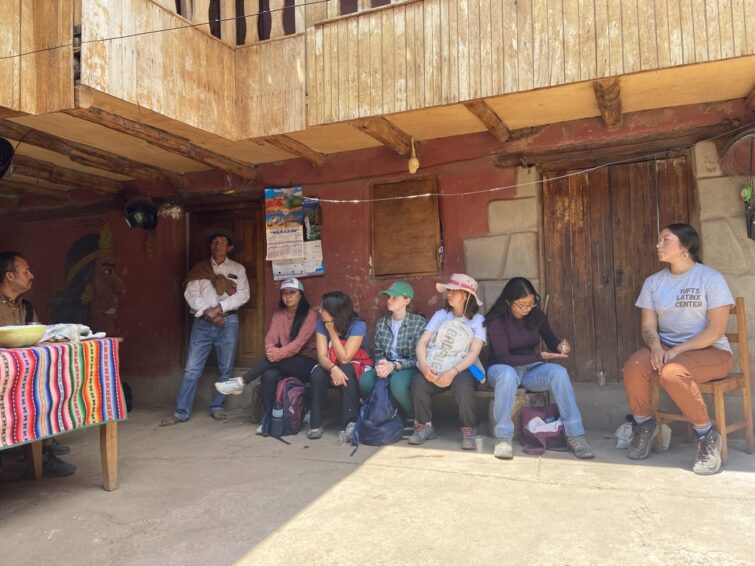
After almost three weeks in the Sacred Valley, it’s become clear that there are hundreds of non-governmental organizations (NGOs) that have planted their roots in these communities, aiming to positively impact lives. Each of these organizations has a distinct mission with very different backgrounds, goals, and staff. We won’t have the opportunity to learn about or interact with the majority of these NGOs, but through the Civic Semester, we will be able to immerse ourselves in two each week.
Of the organizations that we’ve visited so far, two of the three have been international—meaning that the founders, funding, and majority of the staff aren’t from Peru, or even from South America. We’ve done a lot of reflecting on what this means for the organization, and for the impact. We carefully noted whether or not local people are hired on decision-making teams and questioned how this step might change an NGO’s impact.
What is sustainable farming? What does permaculture mean? Why is biodiversity important? And how do you achieve food sovereignty?
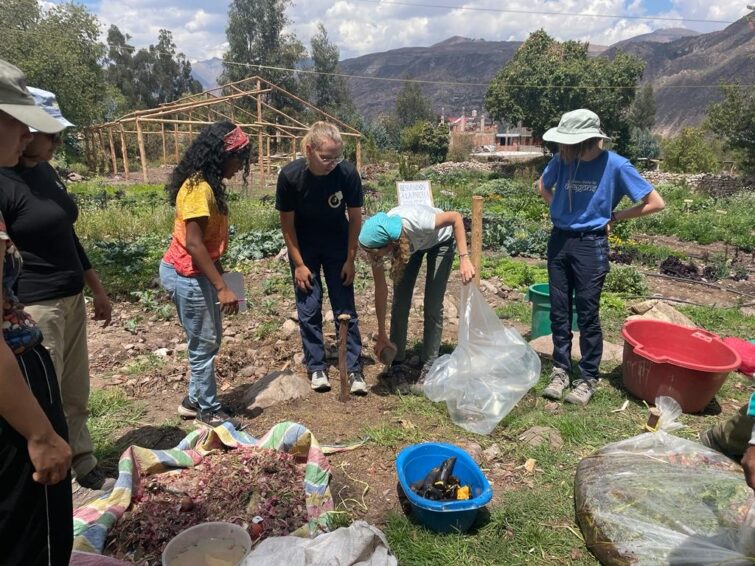
Last week, our cohort visited two local organizations dedicated to organic and sustainable farming in the Andes. One Monday, after a 45-minute walk uphill through unfamiliar streets, we were greeted by Liz, Magda, and Lucía from Canastas Verdes. Canastas Verdes is a small, women-led farming co-op in Urubamba that grows organic vegetables on their own land. Each woman wore a turquoise and gray sweat suit, a matching bucket hat, and a huge smile across their face. The women spoke Quechua to each other and Spanish to us, so Elaine, a student in our cohort, translated throughout the day. At Canastas Verdes, four to eight women work on any given day but there are only three main members who grow crops on the land adjacent to their homes. Liz took us on a tour of her parcel, the first and largest of the three that we would visit. She grew varieties of lettuce, kale, cauliflower, carrots, and other vegetables all within close proximity. Shade was provided by a dozen fruit trees surrounding the perimeter, and Liz gave us a few lemons and lúcumas (a native Peruvian fruit) to try. We passed around the lemon, taking turns biting into the peel and flesh. It was sour and delicious. The lúcuma was in lesser demand, as it had a dry texture like a sweet potato and a very subdued flavor.
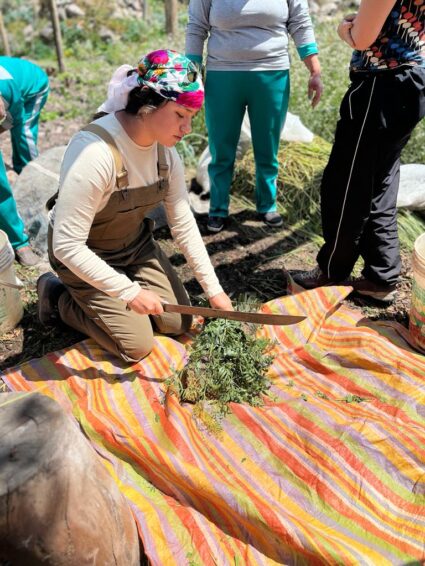
Our first activity at Canastas Verdes was learning how to make organic fertilizer. We took turns chopping alfalfa and barley with a machete, mixing the yeast, water, and sugar in a 5-gallon bucket, and cementing our creation together like a cake. The layers alternated between the grassy mixture, dry leaves, cuy (guinea pig) manure, the water-yeast mixture, and a crushed concoction of eggshells, ash, and dried bird poop. When our stack was up to our knees, we flipped the “cake” over with a pitchfork in order for the ingredients to properly mix. Magda told us that the fertilizer would need to ferment for about three months before it could be used on the farm.
Yesterday officially marked two weeks in Urubamba. It is crazy that in just fourteen days, we’ve learned our way to and from the market, created our own daily routines in the program house, and begun to communicate in local landmarks and inside jokes. We’ve gone through a whole cycle of breakfast crews and have each taken a turn cleaning up lunch and dinner. We know what fruit stands have the best avocados, and what “tourist trap” grocery stores to avoid. We’ve fallen into rhythm with the sun and the moon. I truly feel that we are on the way to becoming a family, and there is nothing that I look forward to more than thirteen other smiling faces at the dinner table each night.
While we’ve been physically in Urubamba for a fortnight, I didn’t feel quite settled until yesterday. After a lazy morning of laundry and YouTube, I put on a clean shirt and pair of jeans, did my hair with a bandana, and packed my fanny pack for a day out. I texted Tsering that I was going to Miga’s, a cafe with the best pain au chocolat in the Sacred Valley, and set foot outside of the house by myself for the first time.
I only had a rough itinerary, and with no Google Maps to consult or time constraint to abide by, I felt free. I just wanted to wander through the side streets and explore the unfamiliar cafes. The walk to the Plaza de las Armas felt so familiar under the soles of my Tevas, and I even stopped the impulse to take a photo of the mountains every three minutes—a real sign of growth.
by Veena, Zhiyi & Iris, Civic Semester Participants
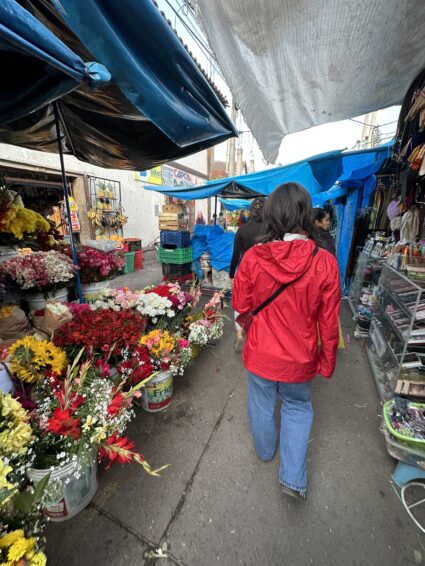
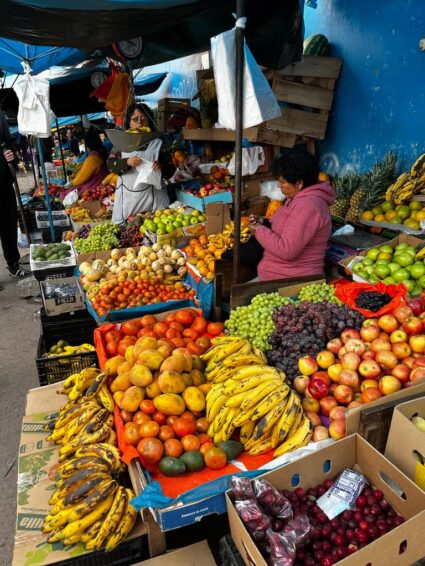
We spent our first evening wandering the plaza and exploring the local market. Vendors selling woven bags, clothing, and hundreds of colorful fruits dressed each corner of the streets. Being in the local market reminded me of home and how desperately I wanted to share the beautiful tropical fruits with my family. It reminded me of my aunt, who stops us on the corner of every street to pick fruits, my grandma’s lemon trees, and my parents and siblings, who display their love by cutting fruit for each other. We entered our new home in Urubamba, welcomed with bananas, apples, and freshly squeezed juice, and at the market with tons of fruits I could never get at home. Sharing fruit is my family’s love language, and knowing that it is a part of the community here makes me feel so much closer to home.
– Veena
It’s very exciting to see all the fruits and vegetables sitting there, group by group, freshly. It seems that they’ve just been picked from the trees. They are not beautiful ones with no stains. Some of them are even wrapped in mud, totally different from what I find in US supermarkets. This scene actually reminds me of home. My family always believes the best and freshest food comes from piles in the market instead of the prettily packaged ones on goods shelves. It is always an amazing experience to discover how tasteful the fruits can be after carefully selecting my favorite ‘ugly’ ones from a large pile. I can’t wait to visit the market more and develop my ability to identify better plants.
– Zhiyi
As the sun set, we gathered on the steps in front of the church, shimmering golden in the late evening light; a group of teenagers gathered outside and began to dance. They wore white and blue skirts over their pants for practice, moving in nearly perfect synchronizations up and down the landing. Teagan and Sophia asked to join them, and before long, a group of us stood in the back, trying our best to keep up. The girls would look back at us every few steps, ensuring we followed along, laughing at our clumsiness. The sun set, the only light coming from the bubbling fountain and church behind us as we all took a bow, our bright rain jackets and their white skirts coming together as we spun and smiled.
by Eleanor, Nica & Ella, Civic Semester Participants
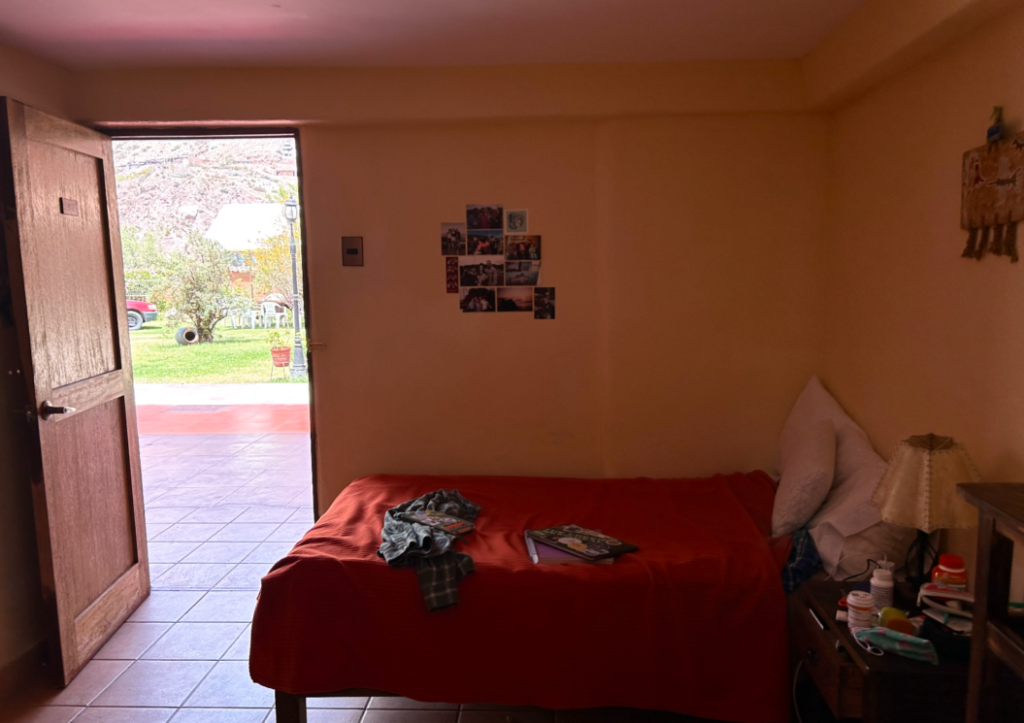
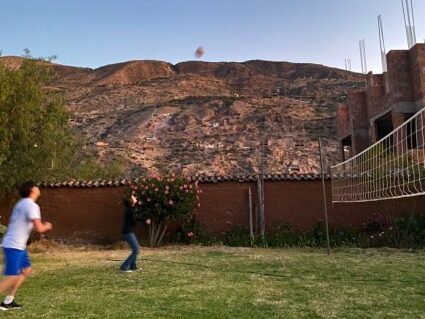
As our van backed into the tight driveway of our home for the next three months, I had no idea where I was. Sure, Urubamba, Peru–I’d been spitting out the name of this city for the last 4 months to anyone asking about my college plans. But where were we, really? Where was the nearest panaderia; how far is the walk to a drug store; what street am I even on? This was a mere 23 hours ago, and today I still have some of the same questions echoing through my head. But, today, I know where to find un Churro Peruano, and how to get to the plaza, and the closest place to buy the toiletries I ditched so my duffel would zip shut. How do you orient yourself to a city, country, and continent completely new to you? In Urubamba, you memorize the mountains. I know what the Andes look like from my window, and how the perspective is different from the plaza. I know which landmarks to look for (most notable: 711 DIMA carved into the mountain directly in front of our house), and how to find my way using them. The mountains are the key to knowing where we are, I hope to never let the magic of this new compass grow dull.
Another unexpected beauty of this compound is how easily sound travels from one side to the other. I was half asleep in the warmest bed when Jacob called out to me from outside, “I can see the Milky Way!” I ran outside, freezing in just my pajamas and socks, to the center of the compound’s grass where Jacob stood and was looking up with a smile on his face. Sure enough, we could see the hazy grouping, clearer than I’d ever been able to see with my town’s light pollution and low elevation. Just as amazing to us as we craned our necks upward was how the constellations were different from the ones we’d seen back home, or at Tufts. Little differences like this, or how half of us nearly took freezing cold showers when the faucet marked “C” was “calor” (hot) and “F” was for “frio” (cold), have made this experience even more exciting, as we learn not to trust what comes to mind first. The sunlight here is extremely direct as we are so close to the equator and so high up in altitude. Sitting in the sun completely encloses you in heat, despite the cool, clear air. Being so connected to the universe by seeing the stars in a new way and feeling the new heat of the sun fills us with renewed gratitude, an occurrence that has happened many times since arriving in Peru.
By moving somewhere completely new to us all, we’re learning to find our way and form perspective using collections of completely new experiences. Whether that’s memorizing the Andes that surround us, studying the shifted constellations, or remembering that C means “calor” and not “cold,” I’m excited to see the new ways that our perspectives are challenged, and expanded. I can’t wait to see the ways that Urubamba becomes home.
Among the many new concepts that I learned during my three days at the Oslo Freedom Forum, I was particularly interested in the term “gender apartheid.” I first heard it used during an afternoon panel on the first day titled “Iran: The Final Revolution?” Human rights attorney Gissou Nia defined gender apartheid by reminding the audience that an apartheid is “the domination of one group over another in order to cement power relations,” and then adding that in the context of gender, an apartheid is “sex segregation to maintain a regime.” Unfortunately, gender apartheid is currently not criminalized under international law, even though racial apartheid is. However, Nia shared that the Convention on Prevention and Punishment of Crimes against Humanity is currently occurring, and with enough advocacy and education, gender apartheid could get included in the convention, and then be used to hold Iran accountable for their heavy repression of Iranian women.
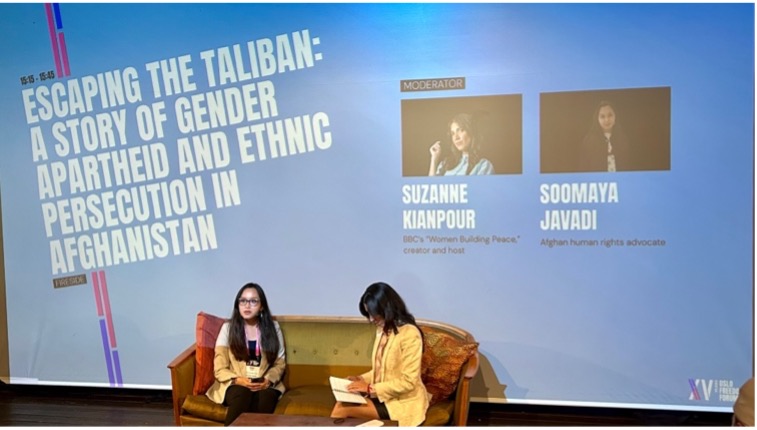
Another mention of gender apartheid came on day three of the conference, during a conversation between Afghan activist and Hazara woman, Soomaya Javadi, and BBC commentator Suzanne Kianpour. Javadi built the case of an ongoing gender apartheid by providing many examples of the Taliban’s violence and mistreatment toward women, such as the 2020 attack at a maternity hospital in the majority Hazara area of West Kabul, where 16 mothers were killed. Javadi also brought light to a 2022 suicide bombing in a West Kabul classroom that killed 35 Hazara women and girls, as well as her personal experiences being forced to wear a veil. When asked why the Taliban goes after women specifically, Javadi explained that women pose a threat to the Taliban should they gain education and a platform in society to where their voices are heard. In this way, the actions of the Taliban line right up with Nia’s definition of gender apartheid, as the Taliban subjugates women in order to ensure the success of the regime.
After learning about the term gender apartheid, I could not help but consider what other stories from OFF 2023 could possibly fall under the definition as well. In addition to being a racial apartheid and genocide, the Chinese government’s treatment of its Uyghur peoples has put the Uyghur women at the disposal of the CCP. In her remarks on the main stage, Uyghur woman and camp survivor Gulbahar Haitiwaji painfully shared that many Uyghur women are forced to sexually entertain male “Han relatives” who come to Uyghur women’s houses when the men of the family are detained in the camps. This sexual exchange is an example of the Chinese government dominating Uyghurs, and specifically Uyghur women, by forcing them into relations.
Another potential example of gender apartheid may be found in some of the African state where women are not granted property rights. Speaking on a panel about the issue, Atlas group member and Sudanese woman Magatte Wade shared that “if you are about human rights, you must be about property rights,” since disallowing women financial freedoms such as the opportunity to build independent wealth has been demonstrated to keep them in abusive relationships, and push women into deep poverty if they become widowed. Also on the panel, Aimable Manirakiza shared that before his group’s efforts, it was written into Burundi law that women did not have property rights, effectively rendering them second class citizens. In the aftermath of OFF, I plan to look more into the potential for gender apartheid being added into the Convention on Prevention and Punishment of Crimes against Humanity. While simply labelling a situation a “gender apartheid” does not automatically push regimes towards equality, it may be a crucial first step toward accountability and justice among the international community.