Recent Posts

Tips for the Burned Out Museum Professional

Tips for the Burned Out Museum Professional

Hopefully, everyone had a relaxing holiday weekend! This week I’m tying in some ideas that I’ve been mulling over since the 101st NEMA conference. The theme was “What’s in it for Me?” and the answer isn’t always clear in our field that has low pay, large 

Weekly Jobs Roundup

Weekly Jobs Roundup

Happy hunting!  South:  Curator (San Jacinto Museum of History, Harris County, Texas)  Digital Content Strategist (Amon Carter Museum of American Art, Fort Worth, TX)  Assistant Curator (Telfair Museums, Savannah, GA)  Museum Diversity Fellow – Museum Education (Reynolds House Museum of American Art, Winston Salem, NC)  

Thinking about design thinking

Thinking about design thinking

I’ve had some exposure to design thinking both professionally and as a student but it has always involved developing a usable product, either physical or digital. It wasn’t until I attended a session at the 2019 NEMA Annual Conference that I realized its potential for programming purposes. In hindsight, that’s an absolute “duh!”

In a session titled Using Design Thinking to Solve Problems Throughout the Museum, Sherlock Terry, Trish Palao, and Jennifer Rickards of the Montshire Museum of Science shared examples of using design thinking for a range of projects including exhibit design, operational challenges, and event planning. They introduced the room to the basics of design thinking, walked attendees through the steps in three Montshire use cases, and then we had the chance to practice it ourselves. (Hands-on learning – my favorite!)

The idea behind design thinking is that it is a human-centered approach. It’s flexible, iterative, and, as most design thinking proponents will tell you, usable by most anyone. It’s not exclusive to people who identify as designers professionally or as a hobby. I’d wager many professionals follow the process intuitively, but may not hit each stage.

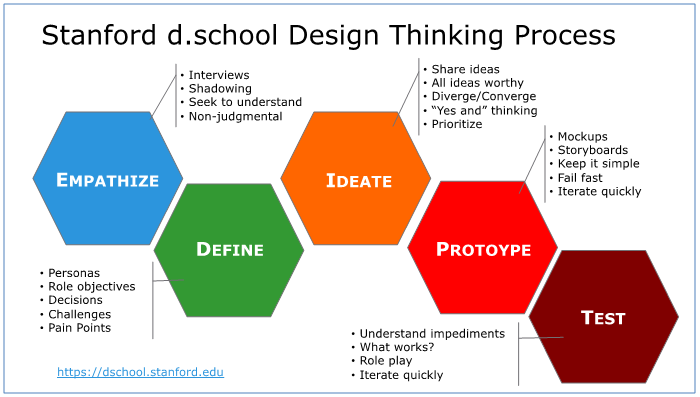
The typical order for the five stages is as follows:

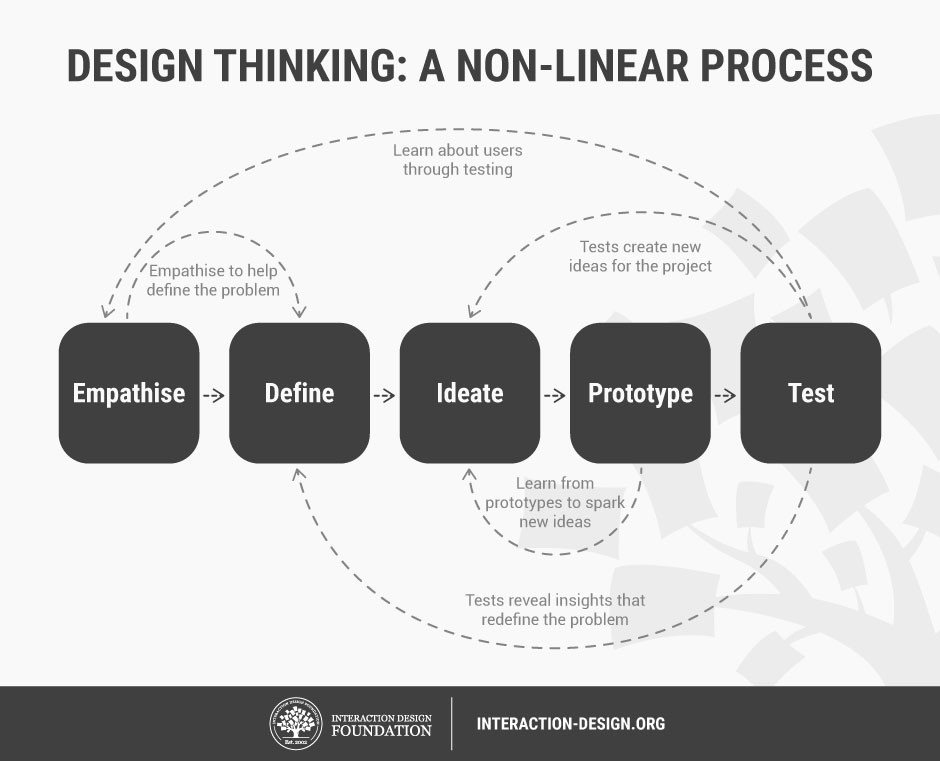
The stages can happen in order, out of order, and repeat as many times as the project requires. Understand your users from their perspective, clearly define what it is they need, brainstorm ways to help, and do a practice run (or three) to see if the project achieves what you hope it will.

This graphic from the Interaction Design Foundation illustrates the cyclical nature of the process:

Copyright holder: Interaction Design Foundation. Copyright terms and license: CC BY-NC-SA 3.0

Design thinking’s focus on user needs and flexibility makes it the perfect multipurpose tool for just about any challenge we might encounter in museum work. As our work is entirely for the sake of our visitors, if our project doesn’t work for the people we serve, it doesn’t work at all – no matter how cool or innovative we think it might be.

If you’re new to design thinking, here are a few helpful tips I’ve learned courtesy of both Montshire staff and the Tufts digital media course:

  1. Enter the process with a well-defined goal to guide you. Our broad goal for the practice scenario in the NEMA2019 session was “How can our museum better engage teens?”
  2. There are multiple ways to think of the problem you are defining – without thinking of it as a problem. Consider it a “job to be done” or build a challenge statement. Montshire staff gave us this template for a challenge statement:
    • How might we [theme goal] in order to [broad goal] considering that [key consideration #1] and [key consideration #2].
    • Example: “How might we train staff in order to better engage teens considering that staff may have little knowledge and/or negative impressions of that age group?”
  3. When brainstorming, go big and broad. Montshire staff came up with 40 ideas during their ideate stages! The idea isn’t to have 40 winners, but to spit out anything that comes to mind. Ideas which might seem totally bizarre or unattainable may have just the right kernel of inspiration.
    • Post-its are your friends here: use one post-it per idea and then group them into themes.
  4. Prototypes don’t have to be physical. Develop the prototype that fits your goal – if you’re designing a program, this might be a lesson plan, a discussion prompt, a question on a sign, a game, a worksheet, whatever. Whatever format lets you test if users are getting what they need is the right format.

Here are some additional resources on design thinking and design thinking in museums:

What uses have you gotten out of design thinking? We’d love to hear your experience in the comments!

Virtual Reality Experience

Virtual Reality Experience

MASS MoCA has virtual reality (VR) experiences from Laurie Anderson, which you can view through 2020. She has developed projects there in the past and was an artist-in-residence. Anderson is a poet, filmmaker, vocalist, and multimedia artist, and the VR experiences of Chalkroom and Aloft showcased that. For both 

Weekly Jobs Round-Up

Weekly Jobs Round-Up

Northeast: Visitor Experience Supervisor (Connecticut Science Center, Hartford, CT) South: Educator for Gallery Teaching (Frist Art Museum, Nashville, TN) Curatorial Assistant (The Menil Collection, Houston, TX) Special Events Manager (Army Historical Foundation, Fort Belvoir, VA) West: Manager of Youth Programs (Academy Museum of Motion Pictures, 

Weekly Jobs Roundup!

Weekly Jobs Roundup!

Northeast: 

Head of Visitor Experience and Services (Wadsworth Atheneum Museum of Art, Hartford, CT) 

Education Program Director (Yale University, New Haven, CT) 

Special Assistant to the Director and Chief Curator (Rose Art Museum at Brandeis University, Waltham, MA) 

Senior Preparator (Colby College Museum of Art, Waterville, ME) 

Development Manager (Tower Hill Botanic Garden, Boylston, MA) 

Engineering Education Associate I (Museum of Science, Boston, MA) 

Live Animal Curator (Museum of Science, Boston, MA) 

Associate Director, Donor Relations (Museum of Science, Boston, MA) 

Production Manager/Audio Specialist (The Institute of Contemporary Art, Boston, MA) 

Associate Registrar (The Institute of Contemporary Art, Boston, MA) 

Prospect Research Manager (Isabella Stewart Gardner Museum, Boston, MA) 

Assistant Preparator/Collections Care Specialist (Wellesley College, Wellesley, MA) 

South: 

Executive Director (Museum of Texas Tech University, Lubback, TX) 

Senior Curator (The Chinati Foundation, Marfa, TX) 

Conservator (Vizcaya Museum and Gardens, Miami, FL) 

Chief Curator (Perez Art Museum Miami, FL) 

Corfrin Curator of Asian Art (Harn Museum of Art, Gainesville, FL) 

Curatorial Assistant (Cummer Museum of Art & Gardens, Jacksonville, FL) 

State Museum of History Associate Director (North Carolina Museum of History, Raleigh, NC) 

Curator of Education, Engagement, and Learning (Jule Collins Smith Museum of Fine Art at Auburn University, Auburn, AL) 

Director of Customer Success, Exhibits and Environments (Solomon Group, New Orleans, LA) 

West: 

Curator of Education & Exhibits (Grace Hudson Museum & Sun House, Ukiah, CA) 

Vice President, Education and Engagement (San Diego Natural History Museum, San Diego, CA) 

Departmental Curatorial Assistant (Santa Barbara Museum of Art, Santa Barbara, CA) 

Registrar and Exhibitions Manager (Yerba Buena Center for the Arts, San Francisco, CA) 

Archivist/Research Historian (Lane County Historical Society, Eugene, OR) 

Non-Profit Partner Executive Director (Fort Collins Museum of Discovery, Fort Collins, CO) 

Associate Director (The Getty, Los Angeles, CA) 

Manager of Campus Partnerships (Stanford University, Stanford, CA) 

Manager of Exhibitions and Publications (Frye Art Museum, Seattle, WA) 

Mid-Atlantic: 

Historic Site Manager (The Maryland National Capital Park and Planning Commission, Rockville, MD) 

Education Program Manager (The Maryland National Capital Park and Planning Commission, Rockville, MD) 

Executive Director (Lee-Fendall House Museum & Garden, Alexandria, VA) 

Special Events Manager (Army Historical Foundation, Fort Belvoir, VA) 

Librarian (Baltimore Museum of Art, Baltimore, MD) 

Director, University Galleries (Montclair State University, Montclair, NJ) 

Director of Development (Woodlawn Conservancy, NY) 

Exhibit Developer/Project Manager (The Wild Center, Tupper Lake, NY) 

Collections Associate (Vassar College, Poughkeepsie, NY) 

Associate Registrar and Coordinator for Exhibitions (Vassar College, Poughkeepsie, NY) 

Curator of Jewish Culture/Judaica (The Jewish Museum, New York, NY) 

Relationship Manager (Carnegie Museums of Pittsburgh, Pittsburgh, PA) 

Midwest: 

Curator and Collections Manager (The History Center, Cedar Rapids, IA) 

Executive Director (Rocky Mount Historical Association, Piney Flats, TN) 

Collections Manager (First Division Museum at Cantigny Park, Wheaton, IL) 

Executive Director (Ephraim Historical Foundation, Ephraim, WI) 

Community Arts Program Director (John Michael Kohler Arts Center, Sheboygan, WI) 

Executive Director (Ohr-O’Keefe Museum of Art, Biloxi, MS) 

Curator (Cleveland Clinic Art Program, Cleveland, OH) 

Deputy Director for Curatorial Affairs and Curator of Modern/Contemporary Art (University of Michigan Museum of Art, Ann Arbor, MI)