Recent Posts

Museum Computer Network (MCN) Scholarships Available! Apply soon

Museum Computer Network (MCN) Scholarships Available! Apply soon

The MCN Scholarship Program awards scholarships to 15 qualified applicants from the cultural sector to attend MCN 2019 in San Diego, CA. The MCN Scholarship program is made possible by the support of our members, sponsors, and conference attendees. Scholars are awarded the following benefits:– 

Do Smaller Museums Better Serve Their Communities?

Do Smaller Museums Better Serve Their Communities?

In conducting my thesis research, I recently came across a quote that really stood out to me and that I think museum professionals can agree on: “The most promising innovations in museums’ relationships with communities are coming not from the largest, oldest, and best-funded institutions, 

Case Studies in Community: The Museum of the Shenandoah Valley

Case Studies in Community: The Museum of the Shenandoah Valley

Often when a museum is dealing with tight margins, dropping interest from local visitors, and growing infrastructure concerns, they are inclined to draw inward, hunker down, and try to weather the storm by protecting the visitors, donors, and physical spaces they need to survive. Unfortunately, this can backfire, further alienating an institution from the very people that can stabilize and enliven it. While it may feel risky, going out into the community can be a pathway to survival and growth for a museum. I recently had the good fortune to meet with one such organization, the Museum of the Shenandoah Valley, who took this route.

The Museum of the Shenandoah Valley (MSV) was created in 2005 with a two-fold mission: To house the fine and decorative arts collections of Julian Glass Jr., whose ancestral estate the MSV is built on, and to collect and share the arts and culture of the Shenandoah Valley. The Museum came about after Glass designated in his will that his family estate, Glen Burnie, become a historic house museum after his death. Glen Burnie opened to the public in 1997 and the house and museum were moderately successful, seeing about thirty thousand visitors a year in 2013. But the MSV seemed unable to grow their visitorship beyond that point and had the all too common experience of small museums where the same group of people was constantly engaged with the site, with little interaction with the larger community.

Executive Director Dana Hand Evans, who came on board around that time saw the potential of the site and set out to bring more people into the MSV. They entered into a phase of strategic planning and created a ten year Master Plan to shape the MSV into a “cultural park” for the town of Winchester, VA and the Valley beyond. Evans made a series of curatorial, programmatic, and financial decisions that resulted in big changes and an uptick in local engagement with the museum.

Some of these decisions were small, but made the MSV more welcoming. They opened up their spaces to local organizations for meetings and other events at no charge. Suddenly the local college had access to an offsite space with a piano they could hold concerts in, and local non-profits didn’t need to search for meeting space, and lines of dialogue were opening up. At the same time, the MSV made the choice to stop pursuing grant opportunities that were open to social services. The Shenandoah Valley is a relatively poor area, with the majority of the students in the public school system eligible for free or reduced lunch. In reducing competition for funding for needed services, the MSV signaled to the community that they wanted to help build the people of the Valley up, not just preserve the memory of the people who lived there in the past.

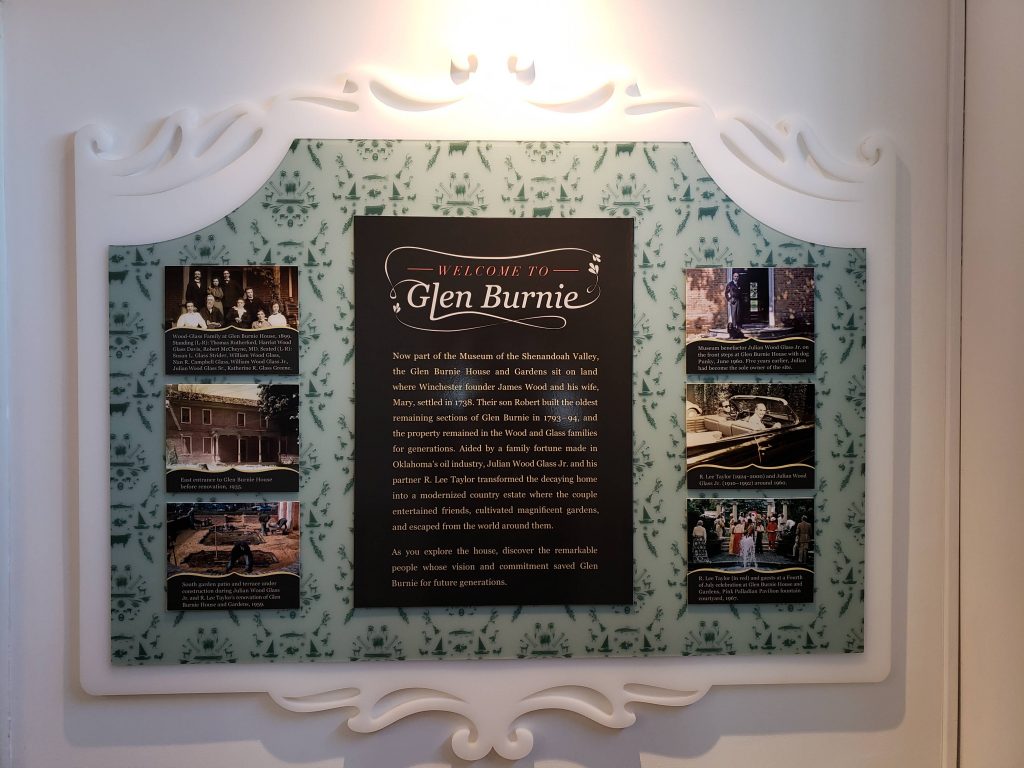
A bigger change was to completely revise the interpretive experience of Glen Burnie, their historic house museum. Previously, the house had been a traditional historic house, with roped-off rooms displaying beautiful objects but with little context about who actually lived in the house. The house needed structural work and they had obtained an NEH grant to remove the contents of the house, do repairs, then reinstall it exactly as it had been before. However, Evans saw an opportunity to do more than maintain the status quo. The MSV undertook a series of listening sessions with community leaders, organizations, teachers, and more to hear their concerns and interests for the site, and to discuss ways to bring more people into the house. Evans and the MSV returned the NEH grant which did not allow for interpretive changes to be made, and sought alternative funding for a new interpretation that featured Julian Glass, Jr. and R. Lee Taylor as central figures in the house, giving visitors a peek into the mid-century life of two gay men who preserved and restored the house and gardens, filled it with fine decorative arts and furniture, and turned it into a social gathering place for their extensive group of friends and family.

Glen Burnie’s new welcome panel, featuring snapshots from Glass and Taylor’s personal collection.

Building on the success of that risk, Evans and the MSV have taken many more steps to build stronger bonds between the museum and the larger community. Local artists are now displayed in a small gallery, and a cafe was turned into a makerspace that offers classes and workshops to the public. Other arts education spaces have also been constructed. Seeking a way to expand use of their considerable grounds, the MSV recently completed fundraising to add three miles of walking and biking trails that will connect them to the larger Winchester Green Circle Trail and expand recreational space access for the community. And a new event oval is currently under construction, allowing the MSV to grow a small annual concert into a concert series that brings in thousands of visitors each summer.

In all, the MSV has doubled its visitorship in the past six years, bringing in over seventy thousand visitors in 2018. It has taken a lot of work, fundraising, and communication, but the MSV is in a better position now that they have devoted themselves to creating and strengthening their community connections. For any smaller organizations out there wondering how to create their own sustainable futures, looking at the MSV’s philosophy may be the key.

Curatorial Innovations Lecture, April 17, 6PM

Curatorial Innovations Lecture, April 17, 6PM

The American Land Museum: Places as Cultural Artifacts Curatorial Innovations Lecture. Free and Open to the Public. Menschel Hall, Harvard Art Museums, 32 Quincy Street Wednesday, April 17, 6:00 pm Matthew Coolidge, Director, Center for Land Use Interpretation The Center for Land Use Interpretation explores how 

Why we should look towards the hospitality industry to improve visitor experience

Why we should look towards the hospitality industry to improve visitor experience

This post was written in collaboration with second year Museum Education M.A. student Taylor Fontes When moving to the Greater Boston Area to pursue my Masters degree in Museum Education, I made a hard decision. I chose to continue working in restaurants (a job I’ve 

From Monument to Memorial: A Symposium Review

From Monument to Memorial: A Symposium Review

“We can’t change the past but we can change history.” -Dr. Kymberly Pinder

On Friday, March 29th, I attended Tufts University’s one-day symposium, “From Monument to Memorial: Space, Commemoration, and Representation in America Now.” Organized by the Department of Art and Art History, the symposium invited audiences to consider the role of public civic art in America and its current impact in our present political climate. Discussions on history, heritage, memory, and legacy were the undercurrents of each presentation.

Before the first panel began, Tufts University Art Gallery Director Dina Deitsch discussed the symposium organizers’ deliberate choice to host the event in Tufts’ Alumnae Lounge, a rather contentious space on campus due to the nature of its monumental murals. Commissioned in 1955, the mural’s east wall depicts the historical founding of Tufts on Walnut Hill, while the west wall shows Tufts students, faculty, and deans in an attempt to provide a “snapshot of student life” in the 1950s. Although there are at least fifty individuals painted between the two walls, almost all of the figures are white, Protestant men (except for a few white women). In fact, the only reference to Medford’s diverse population is a small image of the Isaac Royall Slave House, and the artists completely ignore the fact that Walnut Hill is a site of spiritual significance for the Mystic people.

The Alumnae Lounge murals do not portray the diversity of Tufts University, both past and present. (Stay tuned on updates concerning the murals; there is currently a working group determining how best to make the space more inclusionary. An announcement about the murals’ changes to come will be made in the next few months, according to Deitsch.) Considering the ongoing debates concerning the Alumnae Lounge, the space served as a fitting backdrop for the day’s discussants, with Deitsch’s speech further setting the tone for the issues at heart of each panel.

The morning session, “Local Histories/Contested Spaces,” was comprised of four panelists: Danielle Abrams, Professor of the Practice in Performance at the School of the Museum of Fine Arts; Kerri Greenidge, Professor of History and Director of the Center for the Study of Race and Democracy at Tufts; Diana Martinez, Director of Architectural Studies at Tufts; and Kymberly Pinder, Provost of Massachusetts College of Art.

Each panelist discussed a controversial site, monument, or public art project and the importance of re-contextualizing it in its proper narrative. For instance, Danielle Abrams talked about her research concerning the segregated Lincoln Beach, an amusement park that was open from 1939-1964 in New Orleans. Today, Lincoln Beach is in ruins, and the nearby “whites only” Pontchartrain Beach Amusement Park is often more referenced in the archives. Abrams is working to uncover these archives and prevent the complete erasure of Lincoln Beach from memory by collaborating with the last living generation of individuals who used to frequent the park and can speak to their experiences of segregation.

After the morning panel session, symposium participants and audience members had the opportunity to go on a two-hour guided bus tour led by Kendra Field and Kerri Greenidge of Tufts’ African American Trail Project. The Trail Project is a collaborative effort among students, scholars, and community members, intended to interrogate Massachusetts’ white history. With an aim of placing greater Boston historical monuments in their proper context – that is a narrative that also includes the memory and experiences of “historic African American, Black Native, and diasporic communities,” the Project is bringing to light history that has long been negated. The sites on the tour span five centuries and five neighborhoods of greater Boston, including Somerville/Medford, Beacon Hill, Roxbury, and Mattapan. Some examples of tour stops include the Dorchester North Burial Ground, Bunker Hill Monument, Royall House and Slave Quarters, W.E.B. Du Bois House, the Charles Street Meeting House, and Marsh Chapel. Sites continue to be added to the growing list, and members of the public are welcome to suggest or edit any site.

Mabel O. Wilson, Professor of Architecture at Columbia University, led the keynote address, “Memory/Race/Nation: The Politics of Modern Memorials,” in which she discussed the events of the August 2017 Unite the Right rally in Charlottesville and the University of Virginia’s counter-protesters who shrouded their campus’ statues of Confederate figures in response. While traditionally University of Virginia’s campus tours spoke of Thomas Jefferson’s founding of the school and his legacy, now, thanks in part to increased student pressure, UVA tours highlight a narrative that was silenced for so long, one that acknowledges the approximately six hundred slaves that worked for Jefferson during his lifetime. Furthermore, a coalition of students and staff are “connecting the dots that have been missing,” with a forthcoming Memorial to Enslaved Laborers, a planned campus monument in the shape of a broken slave shackle, on which the names of 660 individuals are engraved along a timeline in a shallow pool of water in “an effort to humanize the unknown.”

As the symposium drew to a close, panelists left the audience with a series of questions to consider. How do we represent highly personal histories, and who do we represent in telling said narratives? How can we reconsider commemoration in light of recent violent events such as the Unite the Right rally in 2017? When should we preserve history, if at all, and what should we do with contentious spaces or monuments? For a room filled with museum professionals, artists, professors, trailblazers, and graduate students, these are timely questions for everyone to think about in our ongoing work of reframing histories.