
Women to the Front: Instrumentalizing Gender Roles in Belarus
By Rosie Berman, Madeline Diorio, Tess Gannaway, and Erica Johnston
Photo Credit: AP-Photo – Evgeniy-Maloletka
Abstract
This study addresses how Belarusian women draw upon traditional femininity and familial structures in order to combat the authoritarian regime of Alexander Lukashenko. Women have taken to the streets to protest in place of husbands, sons, and other male loved ones who are more likely to experience imprisonment, torture, disappearances, and police brutality. This brief will examine how women are using the regime’s conception of Belarusian womanhood to oppose Lukashenko’s continued rule. We will also discuss the ways in which these women’s voices can be successfully amplified in the international arena and explore feasibility of policy recommendations for the international community.
Background
In recent months, Belarus has experienced significant political upheaval and mass protest. Although Belarusian President Alexander Lukashenko has experienced opposition throughout his 26-year tenure as “Europe’s Last Dictator,” he has not faced it at the sustained and massive level seen today.[1] The current discontent with Lukashenko stems from economic stagnation, his faulty response to the coronavirus pandemic, sidelining of political opposition, and ongoing grievances related to authoritarian rule, state-sanctioned police brutality, and gender inequality.[2]
In the leadup to the August 2020 elections, Lukashenko marginalized his three most prominent opponents. Sergei Tikhanovsky, a vlogger who often criticizes government corruption, and Viktor Barbariko, a former banker, were arrested and jailed.[3] Former Ambassador to the United States and founder of a high-tech business park, Valery Tsepkalo was banned from running.[4] A few weeks after Tikhanovsky’s arrest, his wife, Svetlana Tikhanovskaya announced her bid for the presidency in place of her husband. The Belarusian electoral commission approved her candidacy.[5] In July, Veronika Tsepkalo, the wife of Valery Tsepkalo, and Maria Kolesnikova, Viktor Barbariko’s campaign manager joined forces with Tikhanovskaya in their opposition to Lukashenko and support for free and fair elections.[6] Tikhanovskaya soon gained a popular following, despite Lukashenko’s initial judgement that Belarus wasn’t “mature enough” to elect a female president.[7] These women’s ability to run rested largely on the fact that they were women and that Lukashenko underestimated their popularity.
The nation-wide presidential election took place on August 9, 2020. Lukashenko himself announced the results with the claim he had won 80% of the vote.[8] Although elections under Lukashenko have never been viewed as free or fair by the OSCE, this particular election incurred mass response from the Belarusian people in the form of protests during which violent clashes between protestors and state-sanctioned police occurred.[9] Tikhanovskaya has since fled Belarus to Lithuania under direct threats from Belarusian security forces, yet continues to lead the opposition from abroad.[10] Tsepkalo also fled Belarus for her safety, while Kolesnikova famously tore up her passport to prevent exile to Ukraine and has since been detained.[11] Nationwide protests began the night after the election and remain fraught with violence and a substantial amount of arrests both in Minsk and other cities.[12]The European Union, the United Kingdom, Canada and the United States have all placed sanctions on the Belarusian individuals involved with election rigging and state-sanctioned human rights abuses.[13]
Lukashenko is desperately trying to hold on to power. On September 23, 2020 he held an unannounced inauguration ceremony in order to declare himself President once more despite the stark popular opposition to his authority.[14]Western states have threatened further sanctions should Lukashenko fail to come to the negotiating table with the opposition.[15] He has largely ignored these threats and continues to engage in talks with Russian President Vladimir Putin in a bid for economic assistance and political support.[16]
The political situation in Belarus has garnered international attention in part because of the frontline role that women have played and the striking images that have circulated from current protests. Women have become in some ways the face of the demonstrations – attending in large numbers and acting as very visible leaders. Although the involvement of women in these protests and the public sphere appears to be contrary to existing Belarusian gender norms, women protesters are in fact instrumentalizing these gender norms to protect male loved ones and demonstrate their opposition to the regime.
Existing Gender Roles in Belarus
Current Gender Roles in Belarus
Gender norms and roles in Belarus are strictly enforced via societal pressure. Women are expected to fulfill the role of homemaker and remain firmly within the domestic sphere to safeguard and preserve the family unit as wives and mothers.[17] Tenderness, a gentle nature, agreeability and deference to authority are considered to be ideal traits for women. Men, on the other hand are expected to fulfill roles outside of the family unit and home in the public sphere such as political, military, scientific and social roles.[18] Ideal traits for men include assertiveness and independence. Traditional gender roles in Belarus follow a binary conception of gender that excludes sexual and gender minorities.[19]
Women’s Education Rates and Traditional Gender Norms
54.6% of Belarusian women attain higher and special secondary educational degrees, a substantially larger percentage than their male counterparts, of which approximately 37.1% achieve higher degrees.[20] Despite their higher rates of education, most Belarusian women continue to maintain traditional gendered behavior in their family units and society. Patriarchal gender roles that keep women from the masculine public sphere that their studies prepare them to enter are maintained and reproduced in the very educational system that they populate at higher rates. The Belarusian Ministry of Education provides a gender and cultural education guideline for public curriculums stating that students must have an “understanding of a traditional natural culture image of a man and a woman; awareness about socially approved qualities of boys, male adolescents, men and girls, female adolescents and women.”[21] In one 2014 study 47% of female pupils reported being told when they strayed from “feminine” type behavior to recall their ultimate roles as mothers and wives.[22] Although they achieve higher rates of education, women in Belarus still cannot escape their indoctrinated gender roles to break into the public sphere.
Women in Belarusian Politics and Government
Although Belarusian women do not face legal barriers to their participation in government, Belarus lacks legislative and institutional mechanisms for women’s equality. This has led the UN Committee on Elimination of Gender Discrimination against Women to repeatedly express their concern about the participation of women in political and public life in Belarus.[23] The most recently available data from 2014 indicates that Belarus has only one female minister and among the seven chairpersons of the regional executive committees, none are women.[24] Of the 15 officially registered political parties in Belarus, a woman leads only one.[25] On the other hand, more recent statistics for women’s involvement in parliament are available with data from 2019 indicating that women hold 34.5% of seats.[26] While the Belarusian government touts this high number as evidence of a commitment to gender equality, the parliament’s ineffectual nature due to the generalized corruption noted among higher officials, of which none are women, leads this representation to be hollow and not reflective of women’s true involvement. This echoes the patriarchal legacy of the communist-era Soviet Belarus where the Committee of Soviet Women, a group ‘dedicated to Belarusian women’s inclusion in the communist cause,’ has evolved into the current day Belarusian Union of Women.
2020 Protests: Gendered Vulnerabilities and Women Taking Center Stage
Belarus experienced small protests even before the elections took place. However, demonstrations did not grow into a fully-fledged nationwide phenomenon until the day Lukashenko announced his win with 80% of the votes. While the protests have always consisted of both men and women, men vastly outnumbered women in the early days.[27] As men faced increasing violence, women took to the streets in solidarity. Though known for their higher levels of support for Lukashenko, when the older generation witnessed the violence against children in the streets ‘it was the final straw,’ and they too joined the protests.
The ongoing protests in Belarus have different risks, threats, and vulnerabilities for participants depending both on gender and age. Men, since the start of the protests, have faced more serious repercussions for their actions than women. In an interview with The New York Times, one female protestor explains, “Men cannot [fight against a dictator] not because they are weak, but they are more vulnerable. They are being beaten more often.”[28] This section will disaggregate these vulnerabilities and touch on the ways that they have changed as the protests show no sign of slowing down.
Male Risks
Risk refers to the likelihood of being targeted by a given attack, of an attack being successful, and general exposure to a given threat. The risks that male protesters in Belarus face are much more physical and violent than those faced by female protestors. Since the protests began, documented risks include beatings, arrests, imprisonments, torture, and forced disappearance. According to a UN special Rapporteur Anais Marin, just one month after protests broke out over 10,000 protestors had been ‘abusively arrested’ and more than 500 cases of torture reported.[29] As the protests continue throughout Belarus, these numbers continue to rise.
Since the protests began, police targeted the predominantly male protestors by firing tear gas, rubber bullets and stun grenades to disperse crowds.[30] Witnesses have reported to different news agencies the Belarusian Human Rights organization Viasna, that Security Forces have thrown protesters into police vehicles where they were then kicked, punched, and beaten with truncheons.[31] Some witnesses have even reported hearing sounds of beatings and cries coming from inside police barracks and cars.[32] In a video released on August 11, 2020 viewers witnessed male political detainees forced to run through a gauntlet as they are repeatedly beaten with police batons. Other incidents left protesters hospitalized with traumatic brain injuries and broken bones.[33] Doctors have also confirmed a case of male rape, where a police officer put a condom on a truncheon and forced it into a detainee’s anus. While there have been many reported threats of rape by police officers to male protestors, and some men had clothes forcefully cut off, this is the only confirmed case to date.[34] Age exacerbates these risks since the elderly are more susceptible to injuries and prolonged recovery. Security forces attack male protestors regardless of age, and age does not provide any additional protection.
Male Threats
Threat refers to the source and means of a particular type of attack. The threat of these attacks is extremely high for male protesters since the violence they face is state sanctioned. Police are being told to use force, given stun grenades, and full authority to quell protests. The fact that no criminal cases into police brutality or torture complaints have been opened exacerbates these threats.[35] The police and security forces not only lack accountability but are being ordered to carry out abusive actions. Again, these threats do not vary depending on male age disaggregation since age has not proved to hinder the likelihood of security forces using extreme force or violence.
Male Vulnerability
Vulnerability refers to the security flaws in a system that allow an attack to be successful. In the case of Belarus, the Lukashenko regime is itself a vulnerability as it sanctions and encourages the use of force against male protestors. The patriarchy, gender roles, norms, and expectations also represent a vulnerability to male protestors as it is more ‘acceptable’ and understandable to beat men. The police system, lack of transparency and accountability also constitute major flaws in the system which allows for these attacks to take place. These vulnerabilities hold true regardless of age since age does not affect gender norms expected of men or the security services’ approach.
Women Step Out
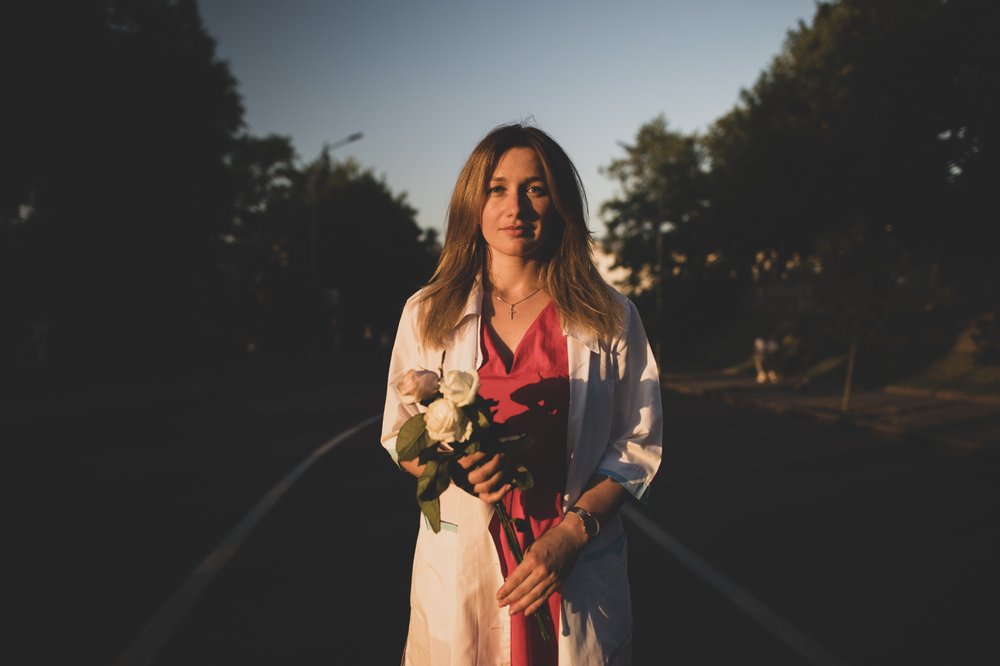
After witnessing the horrors experienced by male protestors in the days that followed the election, women decided to step out in great numbers and take charge of protests. Women understood that because of gender norms and roles within Belarusian society, they did not face the same violent risks, threats and vulnerabilities as men. These women decided to leverage their Belarusian femininity to protect their male loved ones. They did so by creating the image of ‘Women in White.’[36] Women, dressed in white, barefoot, and holding roses soon began marching through the streets of Belarus. They used these images to play on the fact that society views women, especially Belarusian women, as peaceful, loving, caring, and generous. As the women marched, they chanted at police forces ‘Only a coward can beat a woman.’[37] “Belarusian women,” wrote The New York Times in October 2020, “have come to symbolize the peaceful nature of protests and offer a stark contrast to the brutality of Mr. Lukashenko’s robust security apparatus.”[38]
As women marched in the streets, it became clear that the security forces struggled with dispersing and quelling female protestors. Attempts at telling women to go home, take care of their husbands, and act upon expected gender roles, were easily used against the regime. These women were acting in the exact way the government has always wanted them and told them to act. They had not taken to the streets necessarily because they wanted to, but because they needed to in order to assist and protect their husbands and sons. In addition, many women likened their situation to Belarus’s World War Two history and used that history to explain their actions.[39] The war wiped out nearly one quarter of the Belarusian population, mostly men.[40]The absence of men forced women to take on the societal obligations their male counterparts had previously fulfilled,[41] and women played an outsized role in the country’s reconstruction.[42] By drawing upon traditional gender norms and their country’s history, women asserted that their actions as protesters indeed fulfilled their roles within Belarusian society.
Women of all ages – not only wives and mothers – participate in the protests. Female protestors range between teenage girls to great-grandmothers such as Nina Baginskaya, a 73-year-old woman who has been instrumental in fighting the Lukashenko regime and encouraging other women to join the protests. In a now famous video, Nina can be seen hitting a police officer with her purse. The officer does not arrest her.[43] This can be attributed to the expectation that grandmothers and elderly women are to be respected and assisted when needed in Belarusian society. In another video, Nina walks down a stairwell proudly holding her white and red Belarusian flag which has become a symbol of protests. When police asked her where she was going and what she was doing, she responded, “I am going for a walk.” The police officer, obviously torn between stopping her and respecting norms, eventually continued to yell at her while simultaneously grabbing her arm to assist her down the stairwell. Though the most visible of Lukashenko’s elderly opponents, Nina is not alone. The older population holds weekly “pensioner protests” every Monday. The pensioners, including women, have been tear gassed and some briefly detained, but all remain undeterred. Now, the younger population, inspired by Nina and their grandparents are also stepping out in larger numbers. In a recent pensioner protest, students joined chanting, “Together we are the power!”[44]
These women instrumentalized their femininity, challenging the patriarchal regime by acting exactly as it wanted them to. For the first couple days of protests this worked exceptionally well for the women. While their male counterparts were raped, beaten, and tortured, women escaped comparatively unscathed. More recently, however, police have taken a harsher line towards female protestors.
Female Risks
Though only hundreds of women are being detained compared to thousands of men, women detainees still face risks. Those detained were threatened, humiliated, pushed/beaten (less severely than men) and poorly treated. While security forces place women into police vans more gently than they do men, once inside, police have told women that they will ‘rot in jail’ and get gang raped. Some female detainees – though fewer than their male counterparts – also experienced being forced to kneel or stand, with hands tied behind their back, lying on the ground, for several hours before being transferred to cells.[45] While several male journalists were arrested and beaten one female journalist spoke about how they threatened to kidnap her children.[46] However, the most common risk women face at the hands of security forces is an intense amount of persecution, intimidation and harassment.
Elderly women face lower risks. All older women are referred to as ‘grandmothers’ out of respect for the age. Police are not as likely to arrest or threaten these women though they do continue to teargas them. The exception comes with Nina Baginskaya, who has been arrested several times over the decades and now pays off thousands of dollars of fines through a reduced pension. Lukashenko, however, recently announced that he has banned the police from arresting Nina. Her age and status were likely factors in this decision.
Female Threats
When the protests began, women did not face a high level of threat. It was far more difficult at the time for the regime, security and police forces to use overt violence against women. However, this is changing.[47] Security forces, seemingly out of desperation, now threaten and detain women, though still not at the level as their male counterparts. Elderly women continue to face a lower level of threats because unlike elderly men, age provides them with more protection because of gender norms.
Female Vulnerabilities
The vulnerabilities of female protestors within Belarusian society are just now starting to emerge as protests continue. Women, even those who ventured into the public or political sphere were never paid much attention to. Now after weeks of unending protests, led and sustained by women, the security forces are detaining women and making credible threats. They are enabled by the Lukashenko regime which allows it and asks for it to happen.
Challenging the Patriarchy
Belarusian women of all ages have framed their political participation in terms of traditional gender roles and instrumentalized these roles in order to oppose the Lukashenko regime. Still, the very nature of women’s political participation challenges Belarusian gender norms and by extension, the patriarchy. Women have stepped into the traditionally male roles of political leaders and frontline protesters. Tikhanovskaya, Tsepkalo, and Kolesnikova united the opposition to an extent male opposition leaders had previously failed to achieve[48] and presided over the “unprecedented activation of Belarusian society.”[49] Many of Tikhanovskaya’s supporters wanted her to remain in office if she won the presidential election, despite her promise to serve as a transitional figure while new elections were held.[50] Since fleeing Belarus under duress, Tikhanovskaya has launched a Coordination Council made up of civil society activists, lawyers, and respected cultural figures to negotiate a transfer of power[51] and represents the opposition in meetings with Angela Merkel, Emmanuel Macron, and other European leaders.[52] As discussed above, ordinary women of all ages also continue to play a visible role in the public sphere as protesters.[53]
People of all genders recognize the shift in gender roles that women’s actions have produced. “Women were stronger in this situation [that of the protests],” said Tatiana N. Kotes, a film production designer and activist quoted by The New York Times. “We had to assume a more significant role. Men’s dominating role in the society has collapsed.”[54] Women protesters have even emerged as recognized protectors of men, contrary to the norm that establishes men as protectors of women. Aleksei D. Zulevsky, a male protester, shared that he “felt safe for the first time in weeks”[55] surrounded by hundreds of women who shielded him from riot police. “I feel protected here,” Mr. Zulevsky told The New York Times.[56] The regime is alert to this shift as well and as discussed previously, has begun to adapt.
What’s Next?
Before recommendations should be made, the international community needs to continue to monitor the events in Belarus as they unfold, especially as they pertain to the following:
1. Possible changes to the risks, threats and vulnerabilities that men and women continue to face while protesting and to Belarusian gender roles. The international community should pay particular attention to how the security forces and regime treat female protestors – whether they continue to treat them as they are now or if they begin increasing violence against protestors regardless of gender or age.
In addition, the international community should monitor whether gender roles change or remain the same. Through active public participation and increased political leadership and legitimacy, women’s participation has undoubtedly challenged traditional gender roles and the Belarusian patriarchy. The extent to which this challenge succeeds and these shifts in gender roles continue after the protests subside, however, depends on whether Belarusian women are able to preserve the gains they made. Still, Belarusian women at both the elite and grassroots levels have established themselves as resolute organizers and committed activists. Whether they will direct that energy towards organizing as women to defend their access to leadership and the public sphere remains to be seen.
2. The ability for both sides to endure the current status quo. Currently there is no ripeness for ending the protests. Protestors, especially women, are not ready to concede. They have expended too much effort to back down now. They have found their voices, are learning how to use them, and discovering how they can instrumentalize their gender roles in a manner that enhances their role in the public sphere. Furthermore, Svetlana Tikhanovskaya continues to lead the opposition from abroad, encouraging protestors to remain peaceful and resilient. On October 13, she presented Lukashenko with an ultimatum: he steps down by October 25, 2020 or she will call for increased peaceful protests, nation-wide strikes and walkouts.[57]
Lukashenko however remains relatively untouchable. While the OSCE hasn’t recognized the results of the August elections, they have not recognized any elections for the past 26 years. This hasn’t done much to influence the legitimacy of the Lukashenko regime. Additionally, Lukashenko currently has the backing of Russian President Vladimir Putin. Whether Putin remains steadfast in his support of Lukashenko will greatly impact the Belarusian’s regime to remain in power for an extended period of time. This makes it extremely important that the international community continues to pay attention to the relationship between these two leaders. Putin’s support of Lukashenko’s regime is key in his continued power and will play heavily into how long these protests continue and their outcome.
Updates Since October 2020
Since our initial report in October 2020, Belarusian President Alexander Lukashenko has intensified his crackdown on opposition. Security forces have detained an increased number of women protestors. One previously detained women reported a brutal rape with truncheons.[58]
Lukashenko did not step down by the October 25, 2020 deadline given by Svetlana Tikhanovskaya, prompting immediate nationwide walkouts. Within the first 24 hours of the walkouts hundreds of people throughout Belarus were detained.[59]
After being arrested in November for livestreaming an unauthorized protest, two female journalists from Belsat TV were sentenced in February 2021 to two years in prison.[60]
According to the official website of the Belarusian Government, Lukashenko has announced that he will meet with Russian President Vladimir Putin sometime in late February. Lukashenko has also announced that he has plans to meet with Deputy Chairman of the Russian Security Council Dmitry Medvedev. The topics of these discussions has not yet been disclosed.[61]
[1] “Belarus President Alexander Lukashenko under fire,” BBC News, September 11, 2020, https://www.bbc.com/news/world-europe-53637365.
[2] Madeline Roache, “Tens of Thousands Are Protesting in Belarus. Here’s What’s Behind the Uprising Against President Lukashenko,” TIME, August 18, 2020, https://time.com/5880593/belarus-protests-lukashenko/; Madeline Roache, “The Leader of Europe’s ‘Last Dictatorship’ Is Facing an Unprecedented Challenge. Here’s What It Could Mean for Belarus,” TIME, August 7, 2020, https://time.com/5875494/belarus-election/.
[3] “Timeline of election turmoil in Belarus,” RTE News, August 11, 2020, https://www.rte.ie/news/newslens/2020/0811/1158602-belarus/.
[4] Ibid.
[5] Ibid
[6] “Timeline of election turmoil in Belarus,” RTE News; “Belarus election: Opposition disputes Lukashenko landslide win,” BBC News, August 10, 2020, https://www.bbc.com/news/world-europe-53721410.
[7] Yasmeen Serhan, “When Women Lead Protest Movements,” The Atlantic, September 12, 2020, https://www.theatlantic.com/international/archive/2020/09/belarus-protests-women/616288/.
[8] “Belarus election: Opposition disputes Lukashenko landslide win,” BBC News.
[9] “Belarus President Alexander Lukashenko under fire,” BBC News; Scott Neuman, “Belarus President Is Secretly Inaugurated Weeks After Disputed Election,” NPR, September 23, 2020, https://www.npr.org/2020/09/23/916000965/belarus-president-is-secretly-inaugurated-weeks-after-disputed-election.
[10] Serhan, “When Women Lead Protest Movements.”
[11] Ibid.
[12] “Belarus election: Opposition disputes Lukashenko landslide win.” BBC News.
[13] Anders Aslund, “The West finally imposes sanctions on Belarus,” Atlantic Council (blog), October 6, 2020, https://www.atlanticcouncil.org/blogs/ukrainealert/the-west-finally-imposes-sanctions-on-belarus/.
[14] Scott Neuman, “Belarus President Is Secretly Inaugurated.”
[15] “Belarus: Protesters Keep up Push for President’s Resignation,” AP News, October 24, 2020, https://apnews.com/article/alexander-lukashenko-belarus-elections-minsk-europe-0975f64d467ee72f108bba43ad5a54fe.
[16] “Lukashenko seeks Putin’s help in attempt to survive mass protests,” Al Jazeera, September 14, 2020, https://www.aljazeera.com/news/2020/9/14/lukashenko-seeks-putins-help-in-attempt-to-survive-mass-protests.
[17] Dzmitry Ananyeu, Ahniya Asanovich, Anastasiya Darafeyeva, Valentina Polevikova, Volha Salvinskaya and Hanna Yahorava, “Participation of Women in Public and Political Life: Belarus,” (Country Report, East-European School of Political Studies, 2013), https://rm.coe.int/1680599095, 4.
[18] Ibid, 4.
[19] Ibid, 4.
[20] Ibid, 9.
[21] Ibid,” 9.
[22] Tatiana Shchurko and Marina Kuznetsova, “Gender Competence in School: Teachers,” Gender Route, Accessed October 25, 2020, http://gender-route.org/articles/sex_gender_practice/gendernaya_kompetentnost_v_shkole_uchitelya/.
[23] Ananyeu, “Participation of Women in Public and Political Life,” 6.
[24] Ibid, 7.
[25] Ibid, 7.
[26] UN Women | Women Count, “Country Fact Sheet: Belarus,” Accessed October 25, 2020, https://data.unwomen.org/country/belarus.
[27] This information is of our own conclusions after reading reports, interviews, and videos about the August protests. Unfortunately, the media nor the government ever released or acquired disaggregated data.
[28] Ivan Nechepurenko, “Hundreds of Women Arrested at Protest in Belarus,” New York Times, September 19, 2020, https://www.nytimes.com/2020/09/19/world/europe/belarus-protests-women.html.
[29] “Belarus Protests: Opposition icon, 73, among hundred detained in Minsk,” BBC News, September 19, 2020, https://www.bbc.com/news/world-europe-54220414.
[30] “What’s happening in Belarus?” BBC News, September 8, 2020, https://www.bbc.com/news/world-europe-53799065.
[31] Human Rights Watch, “Belarus: Systematic Beatings, Torture of Protesters,” September 15, 2020, https://www.hrw.org/news/2020/09/15/belarus-systematic-beatings-torture-protesters.
[32] Abdujalil Abdurasulov, “Belarus protests: ‘We can breathe for the first time in our lives,” BBC News, August 16, 2020, https://www.bbc.com/news/world-europe-53796989.
[33] Grigory Ioffe, “Bringing Belarus’s Political Crisis to Resolution Requires Realistic Image of Belarusian Society,” The Jamestown Foundation: Eurasia Daily Monitor, October 21, 2020, https://jamestown.org/program/bringing-belaruss-political-crisis-to-resolution-requires-realistic-image-of-belarusian-society/.
[34] Steve Swerdlow, Hanna Liubakova, Tanya Lokshina and Robert English, “Courage Under Fire: Documenting Belarus’ Human Rights Crisis,” (Virtual Panel from USC Global Policy Institute, Los Angeles CA, October 14. 2020).
[35] Swerdlow, “Courage Under Fire.”
[36] “What’s happening in Belarus?” BBC News. https://www.bbc.com/news/world-europe-53799065
[37] Nechepurenko, “Hundreds of Women Arrested at Protest in Belarus.”
[38] Ibid.
[39] Swerdlow, “Courage Under Fire.”
[40] Ivan Nechepurenko, “In Belarus, Women Led the Protests and Shattered Stereotypes,” New York Times, October 11, 2020, https://www.nytimes.com/2020/09/19/world/europe/belarus-protests-women.html.
[41] Swerdlow, “Courage Under Fire.”
[42] Nechepurenko, “In Belarus, Women Led the Protests and Shattered Stereotypes.”.
[43] AFP News Agency. “Belarus Great-Grandmother Protest Star Defies Police Nina Baginskaya Defies Police.” YouTube video, 1:27, September 20, 2020.https://www.youtube.com/watch?v=h_aNDXtQiNo&ab_channel=AFPNewsAgency.
[44] Hanna Liubakova, (@Hannaliubakova), “#Belarus Day 79. Happening right now in #Minsk,” Tweet with video, October 26, 2020, https://twitter.com/HannaLiubakova/status/1320683597066547200.
[45] Human Rights Watch, “Belarus: Systematic Beatings, Torture of Protesters”
[46] Sibilla Bondolfi, “Belarus: Women Protestors Experience Less Violence than Men,” Swiss Info, October 21, 2020, https://www.swissinfo.ch/eng/belarus—women-protestors-experience-less-violence-than-men-/46111074
[47] Ibid.
[48] Swerdlow, “Courage Under Fire.”
[49] Yuliya Talmazan, “They might not win, but 3 women are ‘giving hope’ to Belarus with an unlikely presidential bid,” NBC News, August 8, 2020, https://www.nbcnews.com/news/world/they-might-not-win-3-women-are-giving-hope-belarus-n1236104.
[50] Swerdlow, “Courage Under Fire.”
[51] “What’s happening in Belarus?” BBC News.
[52] Jennifer Rankin and Philip Olterman, “Merkel to meet Belarus’s ‘courageous’ opposition leader in Berlin,” The Guardian, October 1, 2020, https://www.theguardian.com/world/2020/oct/01/merkel-and-belarus-opposition-leader-svetlana-tikhanovskaya-to-meet-in-berlin.
[53] Yuliya, Talmazan, “How Belarusian women became a strong presence in anti-Lukashenko protests,” NBC News, September 20, 2020. https://www.nbcnews.com/news/world/they-might-not-win-3-women-are-giving-hope-belarus-n1236104.
[54] Nechepurenko, “In Belarus, Women Led the Protests and Shattered Stereotypes.”
[55] Ibid.
[56] Ibid.
[57] Sergei Kuznetsov, “Lukashenko Faces Belarusian Opposition Ultimatum,” October 25, 2020, POLITICO, https://www.politico.eu/article/alexander-lukashenko-faces-belarusian-opposition-svetlana-tikhanovskaya-ultimatum.
[58] “I Thought I Was Going to Die,” Хартия’97, December 4, 2020 https://charter97.org/en/news/2020/12/4/402747/.
[59] “Belarus Protests: National Opposition Strikes Gain Momentum,” BBCNews, October 26, 2020, https://www.bbc.com/news/world-europe-54684753.
[60] Ivan Nechepurenko, “Belarus Jails Two Journalists for Covering the Protests,” New York Times, February 18, 2021, https://www.nytimes.com/2021/02/18/world/europe/belarus-protests-lukashenko.html.
[61] “Lukashenko Announces Meetings with Putin in Late February,” Belarus.by, February 18, 2021, https://www.belarus.by/en/press-center/news/lukashenko-announces-meeting-with-putin-in-late-february_i_125817.html.