Image from Professor Wilde’s Twitter Account @flyingless.
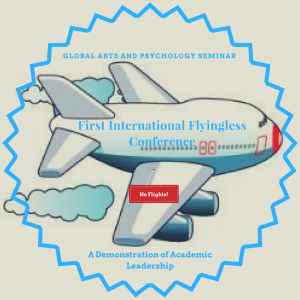
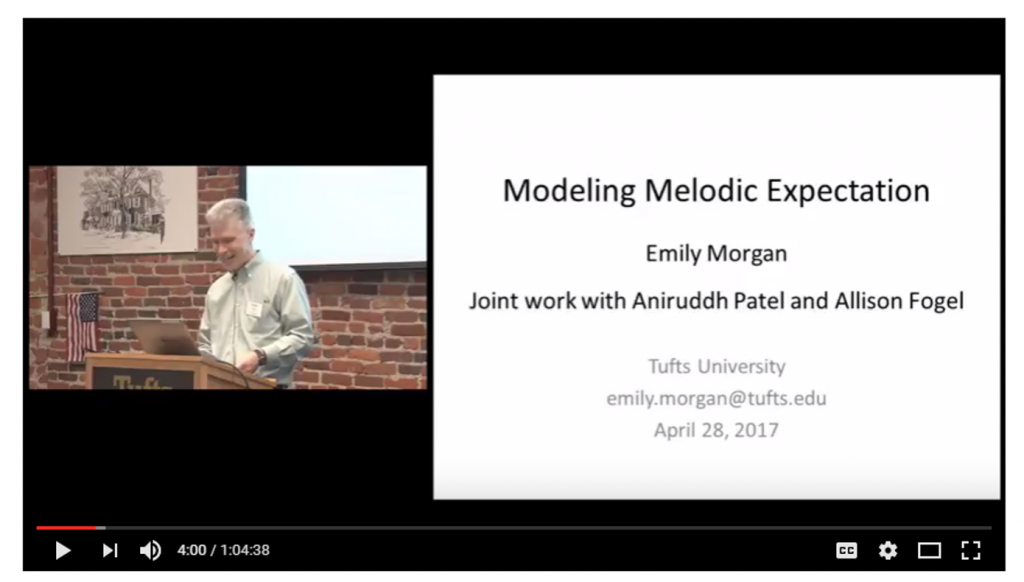
On Friday April 28, 2017, Professor Parke Wilde from the Friedman School—in collaboration with Tufts Professors Richard Auner in Music and Ani Patel in Psychology, graduate students Mehreen Ismail, Victoria Chase, and Ola Ozernov-Palchik, and Professor Mary Farbood from NYU, Andrea Norton from Beth Israel Deaconess, graduate students Maximilian Burkard and Nils Meyer Kahlen, and Professor Richard Parncutt in Graz, Austria—put on the first international flyingless conference called the Global Arts and Psychology Seminar (GAPS). This event was created with support from David Kahle, the Chief Information Officer; Tina Woolston, the Director of the Office of Sustainability; and Bill O’Brien, a Multimedia Specialist. With audiences in Graz, Austria; Sydney, Australia; Sheffield, England; La Plata, Argentina; and Boston, MA, USA, GAPS was quite a successful event.
So why a flyingless conference? Well, Professor Wilde explains this event as a hopeful one in the times of climate change. He continues that communities of universities must be leaders, yet contribute to climate change in traveling to conferences to share research and knowledge. This conference aims to reduce greenhouse gas emissions through a lifestyle change in the academic world. He believes that while some may claim these changes are impossible or will hinder economic activity, “thoughtful people will innovate new ways of living prosperously that have less impact on the environment.”
Part of the solution can come through the many ways we can find fulfillment with minimal impact on the environment. Professor Wilde encourages his audience to think of the list of things that bring joy and happiness without being resource intensive. The professor points to music, mental health, and well-being, a direct link to the topic of the conference that before may have seemed out of place. The professor makes it clear the connection the environment has to so many other fields of studies and aspects of life.
He reminds everyone involved and participating in GAPS, “here today, you are part of something important.”
Content based on the 150th Environmental Studies Lunch and Learn given to professors, staff, and students at Tufts University. Every week during the academic year, the Lunch & Learn lecture series features speakers from government, industry, academia and non-profit organizations to give presentations on environmental topics. This is a great opportunity to broaden your knowledge beyond the curriculum, meet other faculty and students and network with the speakers.
Students, faculty, staff, and members of the community are welcome to attend this lecture series, which is co-sponsored by the Tufts Institute of the Environment and the Tisch College of Civic Life.
The presidency of Donald Trump poses significant uncertainty about the extent to which the United States will continue to make progress on addressing climate change. Ken Kimmell will explore how the incoming administration might rollback policies that have been put in place to address climate change, and make it more difficult for future administrations to address the issue. He will also discuss the progress that is being made in states and regions of the country and the improving economics of clean energy. He will highlight the strategies that the Union of Concerned Scientists and others are likely to employ to limit the damage to our climate objectives and build upon the progress that is being made.
Like many of us, Ken Kimmell, the president of the Union of Concerned Scientists (UCS)—a leading science-based nonprofit that combines the knowledge and influence of the scientific community with the passion of concerned citizens to build a healthy planet and a safer world—see the “dark cloud” surrounding the new political climate; however, Mr. Kimmell is hopeful that its “silver lining” will come in the form of positive change from the people.
In his talk at Alumnae Lounge this March, Ken discussed the darkness in terms of threatened democracy and a “very confused citizenry.” The new administration has been riddled by what Mr. Kimmell refers to as a “factless presidency,” upheld by “alternative facts” and dominated by the belief that climate change is a hoax. Meanwhile, Congress is increasingly captive to special interests that wish to deregulate industries and thwart protection of the environment and human health. And, every day an increasing amount of fake news is published in the media, leading the public to lose trust in the institutions of media, government, and academia to try to “separate fact from fiction.”
At the same time, climate change continues to be a reality faced by many. The Paris Agreement, a global agreement between 197 signatory countries to address and reduce climate change, makes ambitious goals for the U.S. Kimmell explains that this agreement has not been ratified through the Senate and with the new administration’s determination to repeal and prevent climate policy, it will be a great challenge to meet the goals set by the Paris agreement. The administration’s “scorched earth” tactics to dismantle comprehensive climate policy create a long lasting impact on the viability of climate policy. These tactics work hand-in-hand with the government’s “censorship of science” to created what Mr. Kimmell refers to as “Climate Denial 3.0,” in which people do not argue whether or not climate change exists, but instead feel that this determination and proceeding action cannot be made before further “debate and dialogue.” There is a real possibility more funding will be granted to the fringe theories in this “continuing debate,” creating propaganda that sows doubt instead of producing policy upheld by over 20 years of federally-collected data on climate change.
While it may seem a bleak future for the climate movement, Kimmell sees a silver lining in “opportunities to resist, build power, broaden the environmental movement, and revitalize it.” He observes that with “lightning speed, resistance is forming.” People are ready and organizing to mobilize, protect, and expose injustice in changes to federal policy. He also sees the court room as a safety net built into our government, as its decisions and actions are based in factual evidence for actions taken. While the federal government is lagging behind in climate leadership, many cities and states are taking initiative to create climate strategies and goals for increased reliance on renewable energy, clean energy job creation, carbon pricing, cap and trade, zoning codes for smart growth, diversion of food waste, and investment in public transport.
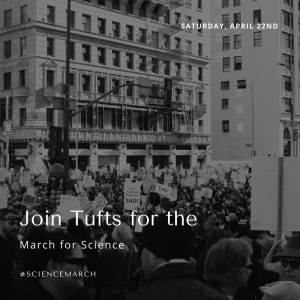
With all this to contend with, what can we do as residents, citizens, students, and academics? Kimmell advises us to lead by example within our institutions, mentioning as an example UCS’s recent divestment from fossil fuels. Another way to make change is to join local movements of resistance and get more civically engaged, contacting your members of Congress and local representatives. There are also national opportunities to stand up in resistance, including the March for Science—focusing on how science and academia can publish, communicate, and engage to reach the groups who need their help—and the People’s Climate March—working to acknowledge the issues of climate, justice, and jobs—both of which are coming up at the end of April.
We have the power to make our voices heard on climate change—a universal issue that “reaches across all people, animals, and landscapes,” and impacts disproportionately the health and security of low-income communities and communities of color. It is important that the environmental movement work with environmental justice communities to elevate the priority of climate change and resist deliberate inaction and oppression collectively.
Content based on an Environmental Studies Lunch and Learn Talk given to professors, staff, and students at Tufts University. Every week during the academic year, the ENVS Lunch & Learn lecture series features speakers from government, industry, academia and non-profit organizations to give presentations on environmental topics. This is a great opportunity to broaden your knowledge beyond the curriculum, meet other faculty and students and network with the speakers. This lecture series is co-sponsored by the Tufts Institute of the Environment and the Tisch College of Civic Life.
Listening for Justice: Place-based Humanities Education and Research
Emma Schneider, Department of English, Tufts University Watch video
How are listening and literature part of promoting environmental justice? How can the imaginative space created by stories promote more equitable and sustainable ways of paying attention to each other and the environment? This presentation discusses how contemporary environmental justice writers ask their readers to listen beyond the powerful narratives that enable exploitative practices. We will think about the role of the humanities in environmental studies and education, particularly in terms of developing a sense of place and community grounded in justice and deep listening.
Do you ever stop to think about whose voices you do not hear? Or what narratives you are not exposed to in the media? How do you decipher “meaningful sound” from background noise?
These are some of the questions Emma Schneider, Ph.D candidate in the Department of English, asks us—a room full of academics in positions of privilege and power—to grapple with in her Environmental Studies Lunch & Learn Talk—Listening for Justice: Place-based Humanities Education and Research.
Environmental justice as defined by the EPA, “is the fair treatment and meaningful involvement of all people regardless of race, color, national origin, or income, with respect to the development, implementation, and enforcement of environmental laws, regulations, and policies.” This is to say that environmental degradation (pollution and resource abuse) and climate change disproportionately burden people of color and low-income communities. This movement aims to bring awareness to and address this economic and legal systematic oppression.
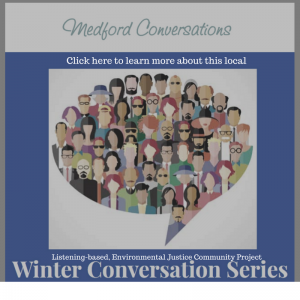
Schneider explains that when it comes to the environment and more specifically environmental and climate justice, we do not lack information or data; our missing link is conversation—a listening gap. She reminds us to listen to the web of different voices in our communities and their stories, because they can help us to re-envision and re-form our world.
As individuals with decision-making powers and privilege, our first response to a perceived lack of outcry at a decision or change is to assume that no one takes issue with it. What if we questioned the silence? Within our legal system, we tend to think of objection or speaking out as the responsibility of those who are affected by policy and decision making. Schneider explains that we tune out “meaningful sound” to calm our own fears and ignore the ways we may be benefiting while others suffer. It can be scary to listen to stories of violence and harm. However, it is pivotal to the survival of communities that people demonstrate courage and listen for these changes from within and outside of their communities. In fact, this important community knowledge can come from those who have experienced transitions to environmental degradation and can recall how the landscape of their community once were.
We are called to create space for those who have something to say, but aren’t being heard. In closing her presentation, Emma asks us “where are the places [in which] connections can be made or bridges can be formed in listening to the things that make us uncomfortable?”
We’re all excited for the upcoming holiday, but let’s also be conscious of our environmental impact. According to the USDA, Americans will throw away more that 200 million pounds of edible turkey meat this Thanksgiving holiday. Here are a few ways to prevent the wasteful and tragic aftermath of Thanksgiving.
Eat local and/or organic. Many Thanksgiving foods like squash, potatoes, and apples are seasonal in the U.S. during the fall and can be purchased from a local farm. Local farms reduce the miles that the food has to travel to get to your kitchen, reducing carbon dioxide emissions. Some local farms are certified organic, but you should ask the farm if they have organic practices. You can also purchase organic produce from a grocery store. Organic produce protects farm workers from harmful chemicals and is safer for humans. Most importantly though, local and organic food tastes better!
Don’t waste food! Americans waste 40% of all food produced in the United States according to the NRDC. You could give out leftovers to guests, eat it as breakfast, or even compost and transform food waste to benefit your garden. “Begin with the Bin” has a great resource for composting leftover food.
Use reusable plates, silverware, glasses, and napkins. This is better for the environment, and no one likes cutting turkey with a plastic knife and having gravy soak through paper plates.
Eat less meat. The meat industry is the largest source of methane gas, which is a major contributor to climate change. You don’t have to be a vegetarian, but try having less meat on the plate and filling the rest of it with healthy sides like squash and green beans! You could also consider purchasing a smaller turkey.
Drink tap water. Americans spend $18 billion on bottled water, which creates mountains of plastic that will stay on this earth for a long time. If you are concerned about the water quality, investing in a filter for your tap water is a wiser alternative.




Find Us On Social Media!