Many museums struggle with maintaining a good balance of technology – enough to attract (and keep the attention of) younger crowds, but not so much that visitors who go to museums to “unplug” are unable to do so. The best solution is to give visitors options. They can sign up for the facebook and the instagram feeds; they can walk past the video touch screens. Our new series, Museums Gone Viral, brings you real ways that museums have used technology and the internet to reach a variety of visitor groups.
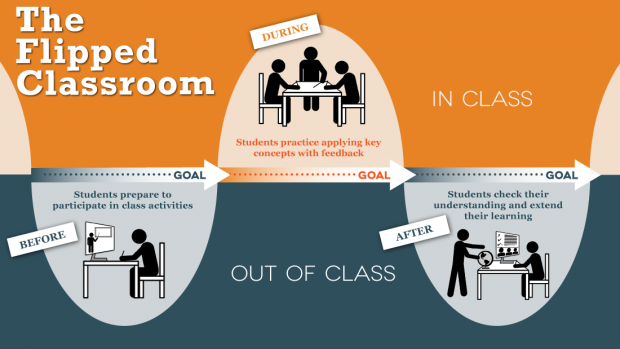
At the North Carolina Museum of Art in Raleigh, students are participating in a new type of visit: “flipped” field trips. The term comes from the idea of “flipped” classrooms, which uses homework to teach the basic facts about a topic, leaving the school time for deeper discussions and more abstract thinking (see the graphic below). The Museum, taking this concept, has created a cooperative, long term collaboration between their institution and schools throughout North Carolina called “Artists in Process.”
Graphic from University of Texas Center for Teaching and Learning
(Click on the photo to enlarge)
Here’s how it works: students are given online access to photos of objects from the collection before they visit the museum. Students can add their own artwork and comments based on certain photos, and eventually place them on a special social media site, revolving around the themes of “identity, place, and storytelling.” One of the truly remarkable aspects of this arrangement is that students are working not only with others in their school, but students from other schools in completely different regions of North Carolina. A large scale conversation is being had before the students even set foot into the museum.
Once they arrive at the museum, they already have a background in the collection, various artistic themes, and how to look at art. Because of this, they can spend extra time looking closely at different pieces, and all without a guide. They are given an ipad, however, in order to photograph different pieces that they would include in their final project: the creation of an exhibition revolving around their chosen theme. Students are allowed to wander the museum and think about how a particular object might fit into their exhibition, and they use sites like Pinterest to virtually create their exhibition. At the end of the field trip, they share their exhibitions.
What I really love about this idea is that it is completely student-centered. Students can pick and choose the objects that hold meaning for them, and because they have an open-ended final project, they are able to consider the art closer, and in different lights than they might if they came for a guided tour. Not only is this project student-centered, but it is long term and community based! Students are able to see worldviews from different areas in their state, and to have a deeper connection with both each other and the museum. Check out this article for how the Museum is evaluating their program and what they have learned from the process.
Further, although teachers reported that students had a hard time sharing their own art and their innermost thoughts, the students were slowly able to begin conversing. Once the ball got rolling, most teachers found that their students embraced the challenge and started sharing more. The fact that the students felt that the community they were working with was supportive helped them to think critically about the art and to discuss ideas about their world. Here is a good article from a third party about the program that includes interviews with teachers who have participated.
It’s an interesting concept, but there are many things to consider, like financial cost, availability of resources like staff time, and evaluation. What do you think? If you are currently working in a museum, do you think this could work for your institution? I would love to hear how different museums (with different resources) think this might work for them.
![Event Planning Intern [Fuller Craft Museum]](https://sites.tufts.edu/museumstudents/wp-content/themes/kale/sample/images/thumb1.jpg)
![Fall internships [Museum of Fine Arts, Boston]](https://sites.tufts.edu/museumstudents/wp-content/themes/kale/sample/images/thumb2.jpg)
![Fall 2015 Registrar/Exhibitions Internships [The Institute of Contemporary Art/Boston]](https://sites.tufts.edu/museumstudents/wp-content/themes/kale/sample/images/full3.jpg)
![Fall 2015 Curatorial Internships [The Institute of Contemporary Art/Boston]](https://sites.tufts.edu/museumstudents/wp-content/themes/kale/sample/images/thumb4.jpg)