Currently viewing the category: "Our Faculty"

One last little note about my vacation travels.  On the flight from Boston to London, I spotted Fletcher Professor John Hammock, who was on his way to Oxford.  Two weeks later, there he was again, on our return flight.  I was a zillion rows behind him on the way home and didn’t have a chance to say hello — though our flight was so thoroughly delayed that I could have shared my entire life’s story!

But seeing Prof. Hammock on the plane reminded me that, many years ago, I found myself on a flight from California with Professor Bill Moomaw.  No one ever wants to talk on a red-eye, but we had a chance to chat on a connecting flight from Pittsburgh (or was it Philadelphia?) to Boston.

And, there was the time that I spotted Michael Klein in the waiting area by the gates at Boston’s Logan Airport.  We were (as usual) going to London.  I think he and his family were on their way to San Juan.

And…there was the afternoon that Graham Bird and I were both waiting at Logan for family to arrive from London.  Prof. Bird teaches in Fletcher’s Summer School, but spends the off-season (i.e., the academic year) at University of Sussex.

Since I don’t really travel all that much, I attribute these shared planes and sightings to the busy travels of the Fletcher faculty.  But since I like to travel, working among so many people who have road-trip tales to share is one of the benefits of my many years at Fletcher.


By alphabetic coincidence, today’s list of book picks includes two on economic issues — but also two books perfect for airplane reading.

Laurent Jacque suggests When Genius Failed:  The Rise and Fall of Long-Term Capital Management, by Roger Lowenstein.

Michael Klein also points us toward books that can help us understand the current economy.  He wrote:  “I hesitate a bit to recommend anything on the financial crisis, since it is such a fluid situation, but a good background to it can be gained by reading  Financial Shock: Global Panic and Government Bailouts — How We Got Here and What Must Be Done to Fix It, by Mark Zandi.  Also, at this time when finance is seen as a problem, it is useful to remember how well-functioning financial markets can help, so I also recommend Saving Capitalism from the Capitalists by Raghuram G. Rajan and Luigi Zingales.”

Julie Schaffner offers the first of the airplane-worthy picks for today:  Mountains Beyond Mountains by Tracy Kidder, which tells the story of Paul Farmer.  (Dr. Farmer also has local roots.)

Peter Uvin, who also offered picks last year, offers an engaging summer read, What is the What, by Dave Eggers.

Finally, alphabetically last but not least, Alexandros Yannis makes two suggestions:  Democracy: A History, by John Dunn, and Postwar: A History of Europe since 1945, by Tony Judt.

As I said in the first picks post, there’s something here for everyone, even if you want to rest your brain this summer.  (Though I also hasten to add that NOTHING is required and brain-resters need not worry.)  I’d love to hear your reaction to the list.  Post your comments — which books have you read?  Any that you particularly recommend to fellow students?  Chime in!

Tagged with:
 

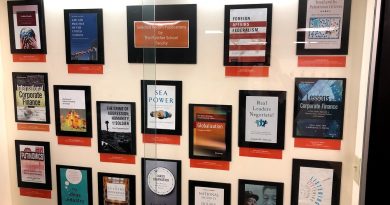
Doing a little pre-Fletcher reading doesn’t mean you need to lock yourself in the library.  Some of the professors’ picks are beach-worthy!  No matter where (or whether) you decide to read, here’s Part II of the professors’ suggestion list.

Michael Glennon offers an array of choices, from a variety of time periods and genres.  Something for every reader!  He lists:

1.    Groupthink, by Irving Janus.
2.    The Arrogance of Power, by J. William Fulbright
3.    The Metaphysical Club, by Louis Menand
4.    Memoirs: 1925-1950, by George F. Kennan
5.    West with the Night, by Beryl Markham
6.    Age of Extremes, by Eric Hobsbawm
7.    Imperium, by Robert Harris

I’m going to try to pick up West with the Night for my daughter — looks like her kind of book, and I might well borrow it back from her.

Donald Gonson not only makes suggestions but provides context for the choices:  “I have two books that might be good for your summer reading list.  One is The New Financial Order: Risk in the 21st Century by Robert J. Shiller.  The focus of corporate governance is increasingly about management of risk these days.  Corporate failure to manage risk has not only put the existence of business institutions in jeopardy, but has threatened the entire global financial system!  With his usual prescience — he wrote widely read and widely admired books about the dot.com and housing bubbles before they burst — Shiller looks at the challenge of managing risk in the modern world.  Other books focus on the specific issues of the current market meltdowns, but this book is useful in that it provides a broader context for our current difficulties.  (It also suggests extremely relevant reforms which could have mitigated our current crisis, if only….)

“The other book I recommend is Guns, Germs and Steel by Jared Diamond.  This is a fascinating look at the evolution of societies, politically and economically, from earliest days.  In fact, the book could well have been subtitled “Early History as a Study in Political Economy,” although that would have been a surprise for two reasons:  Diamond is an anthropologist, and the book is too much fun for such a sober title.  It presents a great analysis of the rise of the rule of law and of the economic forces that shape the law (both very relevant to the study of corporate governance).”

The last picks for today come from Hurst Hannum.  His first suggestion is Farhad Manjoo’s True Enough: Learning to Live in a Post-Fact Society.  His second suggestion is possibly the most intriguing of this year’s list.  He chooses The Plague by Albert Camus.  Certainly a book you can slip in your bag and that will engage you while you wait for your vacation flight.

The final selections, from professors whose last names start with I through Z, will appear next week.  Stay tuned!

Tagged with:
 

Just before classes ended, I sent a note to the faculty asking for summer reading suggestions for incoming students.  (I like to think that this list will be useful for our newest Fletcher students, as well as anyone still reading the blog who will attend a different grad school.)  I’ve collected suggestions before, and ran short lists last summer, and in 2007.  This year I modified my request slightly:  Instead of asking the professors to suggest books that incoming students could read to prepare, I asked them instead for the books they might pass along to a family member who wanted to learn about their area of expertise.  I hoped it would result in some “lighter” reading, and I think it did.

Of course, suggesting that you do preparatory reading contradicts the students’ advice, posted recently.  I’ll just need to leave it to you to decide whether you should follow the advice to relax and recharge, or read one of the books listed below.

One final note:  I only asked the profs for their picks.  I didn’t ask them to elaborate on their choices.  I regret that now, though I think the simplicity of the assignment led to the high number of responses.  I’ll include any comments they happened to send.

So, with no further discussion, here (alphabetically by the professors’ last names) are the first of the book picks.

First, Richard Blackhurst, who teaches the mid-career folk in the GMAP program, suggests Paul Krugman’s Pop Internationalism.  He notes:  “The students will, of course, recognize Paul Krugman’s name. However, this collection of economic essays pre-dates his much more political New York Times weekly columns, and is both very entertaining, accessible, and directly relevant to many — if not all — of the economics and political science courses they will take at Tufts.”

Antonia Chayes gives a little shout-out to her daughter, when she says, “I would add  first and foremost, Sarah Chayes, The Punishment of Virtue: Inside Afghanistan After the Taliban.”  Prof. Chayes also suggests Tom Ricks’s new book on Iraq, The Gamble:  General David Petraeus and the American Military Adventure in Iraq, 2006-2008, as well as A Long Way Gone:  Memoirs of a Boy Soldier, Ishmael Beah’s memoir on child soldiers in Sierra Leone.

Leila Fawaz sends her choice of reading in an area of great interest to many of our students:  Juan Cole’s Engaging the Muslim World.

And last (for today), Brian Ganson suggests Kings of Peace, Pawns of War: The Untold Story of Peace-Making by Harriet Martin (with a foreward by Kofi Annan), and Making Social Science Matter:  Why Social Inquiry Fails and How It Can Succeed Again by Bent Flyvbjerg (translated by Steven Sampson).

That should keep you all busy for the week. :)    More to come soon!

Tagged with:
 

A feature on the work of Fletcher Professor John Hammock appears in this week’s on-line Tufts Journal.  In writing his recent book, Practical Idealists:  Changing the World and Getting Paid, Prof. Hammock worked with Fletcher alum Alissa Wilson.  Alissa is an old Admissions favorite.  She served two years on the Admissions Committee, conducted interviews, and just hung around here being helpful whenever she could.  I should also note that Prof. Hammock is a Fletcher alum, and the parent of a Fletcher alum.


Fletcher’s Summer School ended a few weeks back so nearly everyone who walks through the building is a member of the staff. Besides the occasional professor, the exceptions are several small groups of students in special programs — one for women from Jeddah, Saudi Arabia, one for Critical National Infrastructure Authority officials from UAE, and the third for Armenian Lawyers from Yerevan. I see the students in the library, but there’s not the same level of activity in the Hall of Flags as I’d expect on a normal fall, spring, or winter day. (Check out this newspaper report on the program for Saudi women, and this Fletcher account of last summer’s programs.)

I’ve been keeping an eye out for professors who haven’t yet provided book recommendations. At a reception last week for the special summer students, I thought I had my golden opportunity — but then I saw that all the attending professors had previously provided suggestions. Must remember, next summer, to ask them before they scatter in June! Meanwhile, though, I have a few books to add to your list. (Once again, I’ll mention that these are not required reading. Just suggestions in case you’re looking for a Fletcher-ish book to take to the beach.)

The first pick comes from Prof. Block, who offers several suggestions in his field of development economics: Common Wealth: Economics for a Crowded Planet, by Jeffrey D. Sachs; and One Economics, Many Recipes: Globalization, Institutions, and Economic Growth by Dani Rodrik. He also mentioned The Bottom Billion, by Paul Collier, which Prof. Uvin had previously picked. Now we know that economists would agree with Prof. Uvin’s assessment.

While I was searching high and low for professors to provide book choices, Prof. Aucoin had the poor fortune to cross my path. After I aggressively demanded his recommendation, he suggested Jane Stromseth’s Can Might Make Rights: Building the Rule of Law After Military Interventions.

And, I actually have a few books to suggest from the business faculty. If you are entering the MIB program this fall, you already received these suggestions. For everyone else with an international business interest, besides other more specialized books, the professors recommend Billions of Entrepreneurs: How China and India Are Reshaping Their Futures–and Yours, by Tarun Khanna, and The Panic of 1907: Lessons Learned from the Market’s Perfect Storm by Robert F. Bruner and Sean D. Carr, which sounds like it could be valuable reading for anyone watching the economy right now.

Tagged with:
 

It’s time for a summer reading list from Fletcher professors. Whereas last year’s recommendations stayed close to the professors’ areas of expertise, this year the books span the distance from class reading lists to general interest.

Eileen Babbitt, our negotiation and conflict management guru suggests a book for each of her classes. For D220 (Processes of International Negotiation), she suggests the classic, Getting to Yes: Negotiating Agreement Without Giving In, by Roger Fisher and William Ury. For D221 (International Mediation), she picks Herding Cats: Multiparty Mediation in a Complex World, edited by Chester A. Crocker, Fen Osler Hampson, and Pamela Aall, published by U.S. Institute of Peace Press. And, for D223 (Conflict Resolution Theory) she suggests Building Peace: Sustainable Reconciliation in Divided Societies, by John-Paul Lederach.

In truth, Eileen sent me those suggestions last summer, when I thought I’d post a second list of professors’ picks. Fortunately, she has confirmed that they’re still her picks for this year.

Daniel Drezner, Fletcher’s professor of international politics who has just completed his second year here, selected Robert Gilpin’s Global Political Economy: Understanding the International Economic Order and Jeffry Frieden’s Global Capitalism: Its Fall and Rise in the Twentieth Century.

Academic Dean and Professor of International Humanitarian Studies Peter Uvin provides numerous suggestions that take you from the area of his research to subjects beyond. He starts with The Bottom Billion: Why the Poorest Countries are Failing and What Can be Done About It, by Paul Collier. Never one to miss a chance to kid his colleagues, Prof. Uvin says, “For a book written by an economist, this is not half-bad.”

Moving further afield, he tells me (via email), “I love reading science. I think everyone should understand — or at least feel wonder about — how our world functions. Great books include The Fabric of the Cosmos: Space, Time, and the Texture of Reality, by Brian Greene; A Briefer History of Time, by Steven Hawkins and Leonard Mlodinow, which has really nice pictures; Chaos: Making a New Science, by James Gleick, which is a lot of fun to read, and is directly relevant to social thinking as well; and Visions: How Science Will Revolutionize the 21st Century by Michio Kaku. The last book is particularly interesting as he describes the likely technological breakthroughs for the next 50 years in each field — and how they may affect your life. And then you should read something about our global environment, but I am sure Bill Moomaw will tell you better what that ought to be.” (Note from your blogger — I’ll try to get Prof. Moomaw to weigh in soon.)

Finally, looking after the whole student, Prof. Uvin’s emailed list concludes with Presence: An Exploration of Profound Change in People, Organizations, and Society by Peter Senge and colleagues, and says it “is really useful to help you manage your life in every way.”

It’s still early in the summer, and I hope to post another list soon.

Tagged with:
 

Following up on a previous post, I thought I’d mention that Bernie Kelley-Leccese, a long-time member of Fletcher’s staff, will receive one of this year’s Tufts Distinction Awards at next week’s ceremony. These are the awards for which I was reading nominations in April, so I’m particularly excited that a member of the Fletcher community will be recognized. The staff had a little celebration for Bernie on Friday. It’s so nice when we can celebrate one of our own!

And Fletcher professor Leila Fawaz was recognized for her scholarship when she was named a Carnegie Scholar. You can read more in this article in the Tufts Daily, or on the Carnegie Corporation’s own site. It’s a great honor for Leila, and a wonderful opportunity for her to focus on her research.


Our around-the-office conversation last week about book choices led to a different idea. I asked some members of our faculty (randomly selected on the basis of who is currently in town) what they would recommend to new students who said they would like to do some preparatory reading, but only had time for one book. Some of the professors linked the book to their courses. Others provided a more general recommendation. These might not be the books you would want to take to the beach this summer, but here are some of the professors’ ideas for useful preparation.

Ian Johnstone, one of our international lawyers recommended Foundations of International Law and Politics (edited by Oona Anne Hathaway and Harold Hongju Koh) for his International Organizations course (ILO L220), and Understanding Peacekeeping, written by Alex J. Bellamy, Paul Williams, and Stuart Griffin for his Peace Operations course (ILO L224).

Another member of the law faculty, Joel Trachtman makes a general recommendation: Research Handbook in International Economic Law (by Andrew T. Guzman & Alan O. Sykes), which he notes has a number of excellent papers introducing various topics in international economic law.

Switching to a different Fletcher division, historian Leila Fawaz suggests: Between Memory And Desire: The Middle East In A Troubled Age (by R. Stephen Humphreys). She adds that Guests of the Sheik: An Ethnography of an Iraqi Village (by Elizabeth W. Fernea) is “a wonderful very old book” that is useful for beginners in the field.

Covering a different part of the world, Alan Wachman notes that future students interested in “understanding the narrative of modern China” could begin with In Search of Modern China (by Jonathan D. Spence), while those wishing to focus on Chinese international relations and strategy could look at Cultural Realism: Strategic Culture and Grand Strategy in Chinese History (by Alastair Iain Johnston). His last suggestion for those interested in China, particularly modern China’s history of territorial disputes in Asia, is Imperial Rivals: China, Russia, and their Disputed Frontier (by S.C.M. Paine). But his suggestion for general knowledge is that “every student of international politics ought to read Thucydides’s history of the Peloponnesian Wars.”

As for warfare in a more modern setting, Richard Shultz recommends Utility of Force: The Art of War in the Modern World (by Rupert Smith), which he calls an “interesting walk through the 90s, up to the present” dealing with the changing nature of war.

Last, Alan Henrikson suggests a book that he has, in fact, told his students to start this summer, though they won’t take his course until the spring semester: Postwar: A History of Europe Since 1945 (by Tony Judt). He tells me it’s long (“Tolstoian” is how he refers to it) but that it’s a “perfect book for serious students in international relations and history to read for background” and not only for those interested in Europe.

More suggestions may be coming later in the summer. Rest assured — there’s no required pre-Fletcher reading. But this list may give you a sense of the type of material out there to help you prepare for your graduate studies. Happy reading!

Tagged with:
 

Spam prevention powered by Akismet